



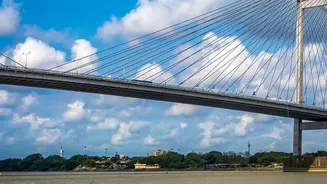
Kolkata is a city of many names, but none capture its grand past quite like the 'London of India'. This moniker harks back to its time as the capital of British India, a legacy etched in marble and stone across its majestic buildings.
The Legacy of a Colonial Capital
For nearly 140 years,
until 1911, Kolkata (then Calcutta) was the most important city in the British Empire after London itself. As the administrative and commercial heart of British India, it was lavished with grand buildings designed to project imperial power and prestige. The British developed the city with wide roads, public squares, and monumental architecture in styles like Neoclassical, Gothic Revival, and Victorian, mirroring the urban design of European capitals. This architectural boom, combined with the city's strategic location on the Hooghly River—similar to London's on the Thames—cemented its reputation as a slice of Britain in the heart of Bengal. Today, these buildings are not just relics; they are an integral part of Kolkata’s living heritage.
Victoria Memorial: The Crown Jewel
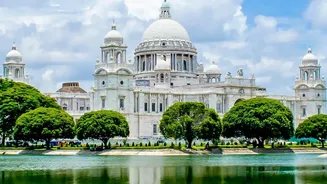
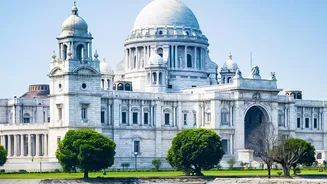
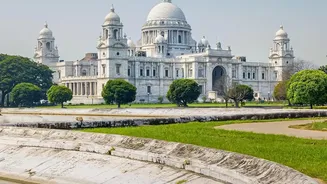
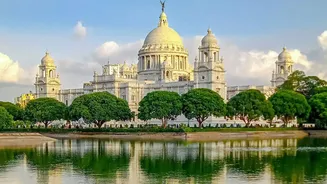
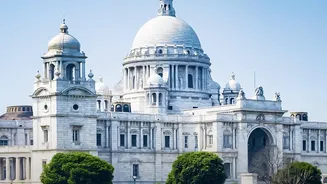
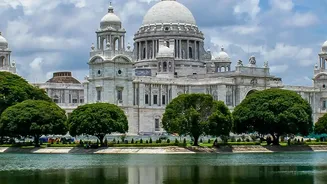
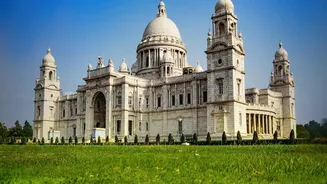
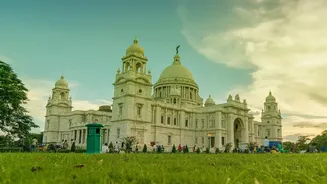
Dominating the Maidan, the magnificent Victoria Memorial is perhaps the most famous symbol of colonial Kolkata. Conceived by Viceroy Lord Curzon after Queen Victoria's death in 1901, this stunning white-marble edifice was designed by architect William Emerson and opened in 1921. Its architectural style is primarily Indo-Saracenic, a blend of British and Mughal elements with hints of Venetian, Egyptian, and other Eastern influences. Made from the same Makrana marble as the Taj Mahal, the structure features a grand central dome, intricate sculptures, and is topped by a 16-foot bronze 'Angel of Victory'. Surrounded by 64 acres of gardens, it now serves as a museum housing a vast collection of art and artifacts from the colonial era.
St. Paul's Cathedral: A Gothic Landmark
A short distance from the Victoria Memorial stands St. Paul's Cathedral, a serene masterpiece of 'Indo-Gothic' architecture. Completed in 1847, it was the first Anglican cathedral built in Asia and was designed to serve the growing European community in the city. Its architect, Major William Nairn Forbes, adapted the Gothic Revival style for India's climate, resulting in its distinctive tall spire, pointed arches, and large stained-glass windows. The interior is just as impressive, featuring a long nave, beautifully carved wooden pews, and two Florentine Renaissance-style frescoes. After suffering damage in earthquakes, its tower was rebuilt, modeled on the Bell Harry Tower of England's Canterbury Cathedral.
Writers' Building: The Seat of Power
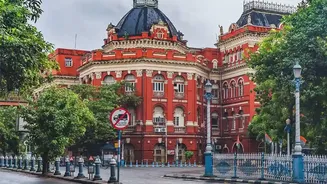
With its striking red_brick facade, the Writers' Building is a monument steeped in political history. Originally built in 1777 by Thomas Lyon, it was Kolkata's first three_storey building. Its initial purpose was to house the junior clerks, or 'writers', of the British East India Company. Over time, it was expanded and given a grand Greco_Roman facade, becoming the administrative secretariat for the Bengal Presidency and, later, the state of West Bengal. The building is also famous for a pivotal event in the freedom struggle: the 1930 assassination of a brutal British officer by three young revolutionaries, in whose honour the surrounding Dalhousie Square was renamed B.B.D. Bagh.
Calcutta High Court: Justice in Red Brick
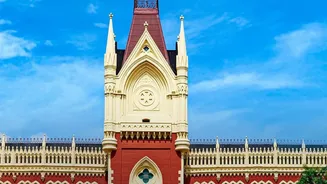
Established in 1862, the Calcutta High Court is the oldest High Court in India. Its building, completed in 1872, is a stunning example of the Gothic Revival style. The architect, Walter Granville, designed it as a replica of the 13th century Cloth Hall in Ypres, Belgium. The imposing structure features a long facade of pointed arches, a tall central tower, and is built from red brick with sandstone and stucco details. It stands as a powerful symbol of the city's long legal history and remains one of the most significant secular Gothic buildings from the colonial period.
Esplanade Mansions: A Touch of Art Nouveau
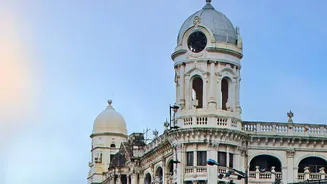
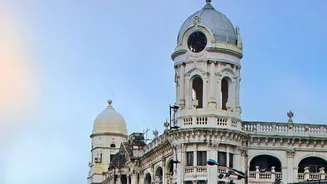
While Gothic and Neoclassical styles dominate, Kolkata also boasts the Esplanade Mansions, a rare and beautiful example of Art Nouveau architecture. Built in 1910 by Jewish businessman David Elias Ezra, this residential building stands opposite the Raj Bhavan. Its distinctive features include a corner tower with a cupola, elegant circular balconies, and flowing arched windows that set it apart from other colonial structures. Once housing 24 sought after flats, it is now owned by the Life Insurance Corporation and hosts various commercial and government offices, preserving its unique architectural flair in the heart of the city.