




The Silent, Ceaseless Hunt
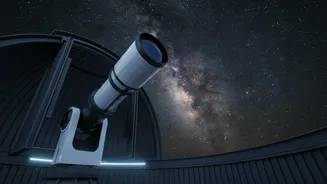
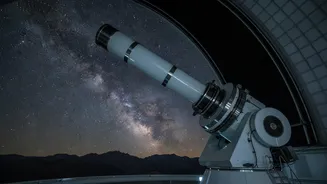
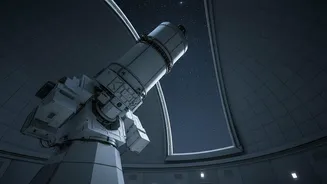
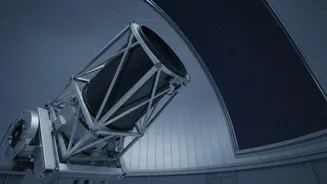
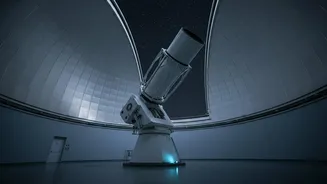
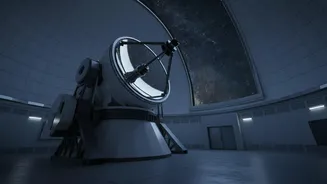
Every clear night, as the world sleeps, a robotic network of eyes opens to the sky. Their mission is planetary defense. This isn't science fiction; it's a coordinated global effort to find and track near-Earth objects (NEOs)—asteroids and comets whose
orbits bring them close to our planet. The goal is to catalog any object large enough to pose a threat, preventing a catastrophic surprise. NASA's Planetary Defense Coordination Office (PDCO) oversees this effort, tasking survey programs to find at least 90% of NEOs larger than 140 meters—big enough to destroy a large city. This silent hunt is our first line of defense against a potential impact, transforming what was once the domain of fate into a manageable risk.
The Eyes on the Sky
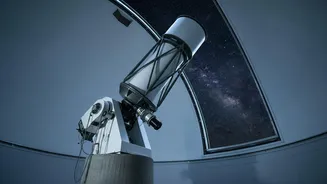
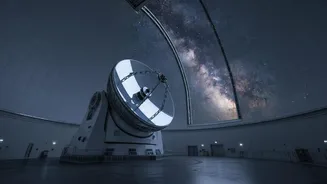
Several key survey systems form the backbone of this planetary defense network. Programs like the Catalina Sky Survey (CSS) in Arizona and the Panoramic Survey Telescope and Rapid Response System (Pan-STARRS) in Hawaii have been the workhorses of asteroid detection for years. Pan-STARRS, located on Maui, has been a leading force, discovering over half of all new large NEOs since it began full-time searching. More recently, the Asteroid Terrestrial-impact Last Alert System (ATLAS) has joined the watch. ATLAS consists of four telescopes in Hawaii, Chile, and South Africa, allowing it to scan the entire night sky every 24 hours. Unlike deeper surveys that search for large asteroids years away, ATLAS is optimized to provide a final warning for smaller, but still dangerous, objects that may be only days or weeks from a potential impact.
How to Spot a Moving Rock
Finding a small, dark object millions of kilometers away is a technological marvel. The method is simple in concept but complex in execution. Telescopes take a series of four or five images of the same patch of sky, spaced several minutes apart. Sophisticated software then compares these images. Stars and galaxies remain stationary relative to each other, but an asteroid or comet will have moved slightly between each exposure. Once a moving object is flagged by the software, human observers often review the candidates to verify the detection. This process of taking multiple snapshots and playing them back like a short movie reveals the faint specks of light that are moving against the fixed background of stars, betraying their status as nearby travelers in our solar system.
From Detection to a Global Alert
Once a potential NEO is spotted, the clock starts ticking. The observations are immediately sent to the Minor Planet Center (MPC), the international clearinghouse for all asteroid and comet data. The MPC posts the data online, allowing astronomers worldwide to perform follow-up observations. These additional sightings are crucial for calculating the object's orbit with precision. This data is then fed into systems like the Center for Near-Earth Object Studies (CNEOS) at NASA's Jet Propulsion Laboratory. CNEOS computes the object's trajectory for the next 100 years, assessing any potential impact risk. If a credible threat is identified, the PDCO is responsible for issuing warnings to the government and the public, providing as much lead time as possible for mitigation efforts, which could include evacuation.
The Next Generation of Planetary Defense
The hunt is about to get a major upgrade. The Vera C. Rubin Observatory, which began its ten-year survey of the southern sky in July 2026, is a revolutionary tool for planetary defense. Its massive camera and wide field of view will dramatically increase the rate of asteroid discovery. Joining it will be NASA’s NEO Surveyor, a space-based infrared telescope planned for launch in the coming years. By detecting the heat emitted by asteroids, NEO Surveyor will be able to find them even if they are dark and reflect little sunlight. It will also be positioned to spot objects that are difficult to see from Earth because they are located in the direction of the sun. Together, these new observatories will help complete the catalog of potentially hazardous objects, ensuring that very few surprises are left lurking in the dark.