




The Allure of Alien Artifacts
When we see images from the Red Planet, our brains are wired to find familiar patterns. This psychological phenomenon, called pareidolia, is the same reason we see faces in clouds or animals in rock formations. It's a natural human tendency, and on a world
as alien as Mars, it's easy to see why a strangely shaped rock might look like a severed head or a fossilised femur. The first, low-resolution image of the "Face on Mars" in 1976 sparked decades of speculation, even though later, clearer images showed it to be just a mesa. Today, with high-definition images arriving daily, every oddity can become an instant online sensation, fueling theories of lost civilizations before scientists even have a chance to weigh in.
Nature's Sculpting Power
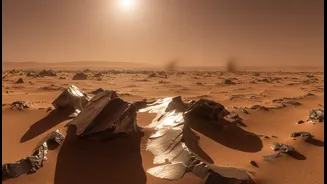
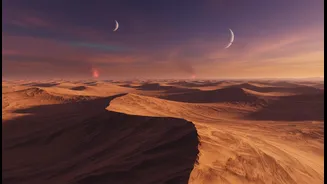
The most common culprit behind Mars's weirdest rocks is wind. Over millions of years, sandblasting winds carve rocks into strange shapes called ventifacts. These can have facets, flutes, and grooves that look remarkably artificial. A shiny object that resembled a door handle, photographed by the Curiosity rover, was identified as a ventifact—a hard, fine-grained rock polished smooth by the wind. This constant erosion can expose fresh rock faces that haven't been covered in red dust, making them appear shiny or metallic in the harsh sunlight. This process is common on Earth in arid regions but is even more pronounced on Mars, which is essentially a planet-sized desert.
The Case of the 'Blueberries'
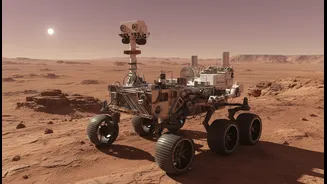
One of the most famous Martian curiosities were the small, spherical objects discovered by the Opportunity rover. Nicknamed "blueberries," these hematite-rich concretions were startlingly uniform and spread across the landscape. While they looked manufactured, they were a key piece of evidence for a watery past. These spherules are concretions, formed when minerals precipitated out of water that had soaked the ancient bedrock. Similar, though not identical, formations can be found in places like Utah, providing a terrestrial analogue for these alien-looking pebbles. Rather than being alien marbles, they are geological records of a time when Mars was a wetter, more dynamic world.
When It Is Actually Metallic
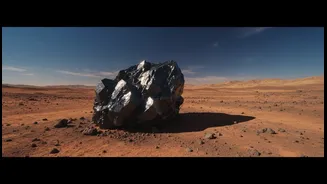
Sometimes, when a rover finds a metallic-looking object, it's because it's actually metal. Just not alien metal. Mars is frequently bombarded by meteorites, and because its atmosphere has so little oxygen and moisture, iron-nickel meteorites don't rust away like they do on Earth. They can remain on the surface for millions of years, looking distinctly out of place. The Curiosity rover has found several, including a foot-wide meteorite dubbed "Cacao" and a much larger one called "Lebanon." These space rocks are exciting discoveries for scientists, offering clues about the solar system, but they aren't evidence of Martian technology.
Our Own Litter on Mars
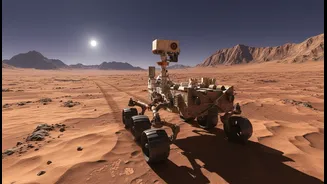
There's another source for metallic objects on Mars: us. Every mission to the Red Planet has involved shedding hardware. Parachutes, backshells, and heat shields are jettisoned during the complex landing sequences. In 2022, the Perseverance rover discovered a piece of its own thermal blanket wedged between rocks, a surprising two kilometres from its landing site. The shiny, foil-like material was an unambiguous piece of human-made trash on another world. While these discoveries can be momentarily confusing, they are easily identifiable by the mission teams and serve as a reminder that as we explore other worlds, we've already started to leave our mark—and our litter—behind.