






The Sun’s Enduring Riddle
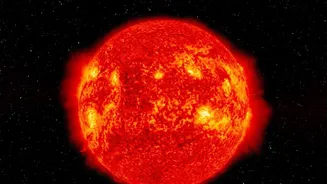
Imagine standing by a campfire. As you move away, the air gets cooler. This is a basic law of physics. Yet, the Sun breaks this rule spectacularly. Its visible surface, the photosphere, has a temperature of around 5,500 degrees Celsius. But its outer
atmosphere, the corona, sizzles at a staggering one to two million degrees, and can even spike to 40 million degrees during energetic events. This phenomenon, known as the 'coronal heating problem', has puzzled solar physicists for over 80 years. How does the atmosphere get hundreds of times hotter than the very source of its heat? Scientists have long suspected the answer lies in the Sun's powerful and complex magnetic field, but gathering definitive evidence has been a monumental challenge.
India’s Eye on the Sun
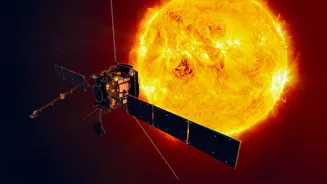
Enter the Indian Space Research Organisation's (ISRO) Aditya-L1, the nation's first dedicated mission to study the Sun. Launched in September 2023, the spacecraft travelled 1.5 million kilometres from Earth to a unique parking spot in space called Lagrange Point 1 (L1). From this vantage point, Aditya-L1 has an uninterrupted, continuous view of the Sun, without any eclipses or occultations. This allows it to monitor solar activity 24/7, a crucial capability for studying dynamic phenomena. The mission's primary scientific objectives include understanding coronal heating, the physics of solar flares, and the drivers of space weather that can impact our planet.
A Suite of High-Tech Tools
Aditya-L1 is equipped with seven sophisticated payloads designed to observe the Sun in different ways. For the coronal heating puzzle, two instruments are particularly vital: the Visible Emission Line Coronagraph (VELC) and the Solar Ultraviolet Imaging Telescope (SUIT). VELC is designed to study the corona in incredible detail, observing its temperature, velocity, and density very close to the solar disk. SUIT, on the other hand, captures images of the lower layers of the Sun's atmosphere—the photosphere and chromosphere—in ultraviolet wavelengths that are invisible from the ground. By combining data from these instruments, scientists can connect events happening on the Sun's surface to the dramatic heating that occurs high up in the corona.
Decoding the Mystery with Nanoflares
Recent findings from Aditya-L1 have provided some of the strongest evidence yet for a leading theory behind coronal heating: nanoflares. A nanoflare is a tiny explosion, a billion times less powerful than a regular solar flare, but they are thought to happen constantly all over the Sun. The theory, proposed decades ago by Eugene Parker, suggests that the constant churning of the Sun's surface twists and braids magnetic field lines in the corona. Eventually, these tangled fields snap and reconnect, releasing bursts of energy that collectively heat the corona to its extreme temperatures. Data from Aditya-L1 has provided what some scientists call the 'smoking gun' for this theory. Observations have shown a direct link between these small-scale magnetic reconnections and localised spikes in coronal temperature, suggesting they are the primary energy source. One study attributed as much as 93% of the corona's heating in a studied event to this process.
Why This Discovery Matters
Solving the coronal heating problem isn't just about satisfying scientific curiosity. The same magnetic processes that heat the corona also drive explosive events like solar flares and Coronal Mass Ejections (CMEs). These eruptions hurl vast amounts of charged particles into space. When directed at Earth, they can trigger geomagnetic storms that disrupt satellite communications, damage power grids, and pose a risk to astronauts. By understanding the fundamental physics of the corona, scientists can improve their models for predicting this 'space weather'. The data from Aditya-L1 is a crucial step towards better forecasting, helping to protect our increasingly technology-dependent infrastructure.