


A New Look at an Old Friend
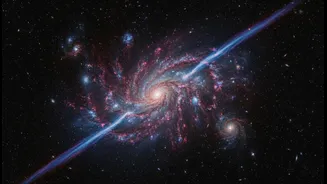
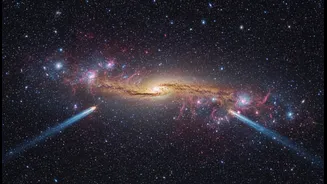
Take Centaurus A, a galaxy just 11 million light-years away—a stone's throw in cosmic terms. It’s one of the brightest and most studied objects in our night sky. For decades, astronomers have seen it as a galaxy with a violent past, scarred by a prominent
belt of dark, light-absorbing dust. But recently, the James Webb Space Telescope (JWST) turned its powerful infrared eyes on Centaurus A and saw something entirely new. Webb’s ability to peer through the dust that has long obscured our view is like having a key to a locked room in a house you thought you knew completely. Where other telescopes, like Hubble, saw an impenetrable dusty lane, Webb has revealed a cascade of individual stars and glowing gas, fundamentally changing our portrait of the galaxy.
Uncovering Bizarre Shapes
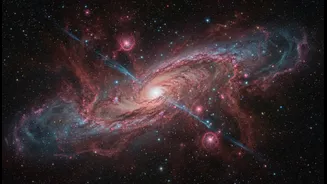
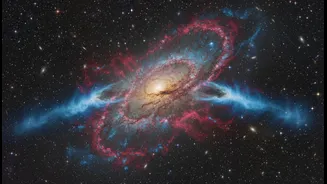
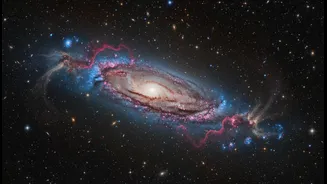
Within this newly revealed interior, Webb discovered structures that have left astronomers both surprised and intrigued. The observations highlight a strange, parallelogram-shaped band of dust cutting across the galaxy's center. Even more unusually, data from Webb's Mid-Infrared Instrument (MIRI) shows a wispy, S-shaped feature curling around the core. These aren't random patterns; they are organized structures that previous observations simply could not detect. Finding them is the astronomical equivalent of discovering ancient ruins hidden beneath a dense jungle. Astronomers are now working to understand what could have created these shapes. The leading theories point to the galaxy's turbulent history: a major collision with another galaxy roughly two billion years ago and the ongoing activity of a supermassive black hole at its core.
Echoes of a Violent Past
These hidden details are more than just cosmic curiosities; they are fossil records. Centaurus A is an active galaxy, meaning its central black hole is furiously consuming material and blasting out powerful jets of energy. This activity, combined with the aftermath of its ancient merger, creates a complex interplay of forces that can both trigger and suppress the birth of new stars. The newly discovered dusty structures provide a direct view of this process. By studying how gas and dust are distributed and how they move, scientists can better understand how a black hole’s influence extends across an entire galaxy. Each filament and glowing region tells a story about the collision that shaped Centaurus A and the engine that continues to drive its evolution.
A Universe of Hidden Structures
The revelation in Centaurus A is not an isolated case. This theme of finding new details in familiar places is playing out across the cosmos. In our own home, the Milky Way, astronomers have recently discovered dozens of previously unknown stellar streams. These are faint, arcing ribbons of stars that are the ghostly remnants of smaller dwarf galaxies and star clusters that our galaxy consumed billions of years ago. Other research has shown that the vast, diffuse halo of stars surrounding the Milky Way is not spherical, but tilted and shaped like a football, a clear sign of a past major merger event. Even more surprisingly, some of these discoveries are being powered by networks of advanced amateur telescopes, proving that anyone with the right equipment and patience can contribute to unveiling the cosmos. These findings all reinforce the same idea: galaxies wear their histories in faint, subtle ways, waiting for the right tools to bring them to light.