


Seeing the Unseen Heat
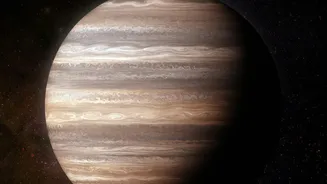
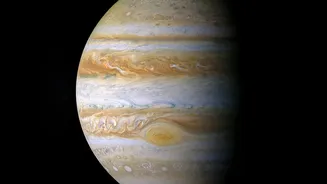
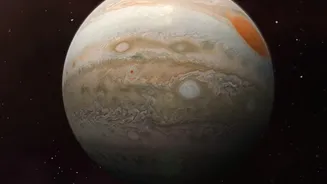
When we look at Jupiter through a standard telescope, we see the beautiful, swirling bands of its upper cloud decks. But what we don't see is the incredible heat churning beneath and radiating out into space. All warm objects, from a person to a planet,
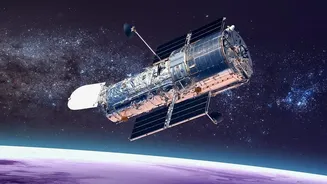
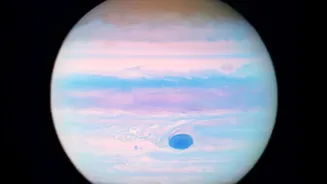
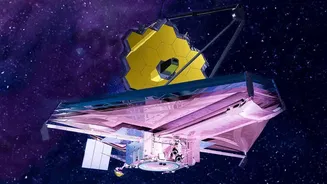
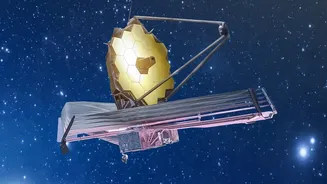
emit infrared radiation. Gas giants like Jupiter and Saturn emit even more infrared energy than they receive from the Sun, a result of leftover heat from their formation and ongoing gravitational contraction. This thermal emission is invisible to our eyes but provides a treasure trove of information. Infrared telescopes, like the powerful James Webb Space Telescope (JWST), are designed specifically to detect this light, allowing scientists to bypass the visible clouds and probe the deeper, dynamic layers of a planet's atmosphere.
Decoding Light to Read the Atmosphere
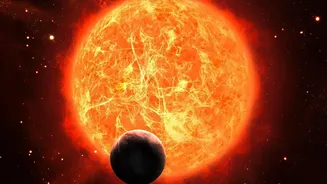
The process of observing this weather is a marvel of remote sensing. As a planet passes in front of its star, the star's light filters through the planet's atmosphere. Different molecules in that atmosphere absorb specific wavelengths, or colours, of light. By analyzing the resulting light spectrum—essentially a rainbow with specific colours missing—scientists can identify the chemical composition. This technique, called spectroscopy, reveals the presence of gases like water vapour, methane, and carbon dioxide. For example, JWST has provided clear evidence of carbon dioxide in the atmospheres of exoplanets in the HR 8799 system and methane on another distant world. This chemical fingerprint is the first step to understanding the atmospheric dynamics.
Mapping Temperatures to Track Storms
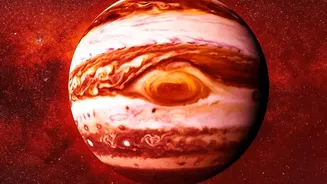
Temperature is the engine of weather. By measuring the intensity of infrared radiation at different wavelengths, astronomers can create detailed temperature maps of a gas giant's atmosphere. Hotter areas, where air is likely rising, glow brighter in infrared, while cooler areas are dimmer. These temperature gradients are directly linked to atmospheric motion and pressure, allowing scientists to infer the structure and behaviour of massive storm systems. Recent observations of Jupiter's Great Red Spot with JWST surprised scientists by revealing intricate structures and unexpected activity in the upper atmosphere, a region previously thought to be relatively bland. This ability to map thermal structures provides crucial data for understanding how these giant, long-lived storms are powered.
Clocking Supersonic Winds
One of the most astonishing discoveries has been the measurement of incredible wind speeds. To do this, astronomers use a technique similar to creating a time-lapse video. Telescopes like JWST take a series of high-resolution infrared images of a planet at set intervals, sometimes just hours apart. They then track the movement of specific features, like small, bright clouds of ammonia ice, between frames. By measuring how far a feature travels and dividing by the time elapsed, they can calculate wind speed. This method led to the discovery of a powerful jet stream high above Jupiter's equator, blasting along at over 500 kilometres per hour—nearly twice the speed of the winds in the visible cloud layers below. Such findings give us insight into how different layers of these turbulent atmospheres interact with each other.
Challenges and the Future
Observing these distant weather patterns is not without its difficulties. Thick cloud or haze layers can obscure the atmosphere beneath, making it difficult to detect key molecules like water. Furthermore, for many exoplanets, the faint light from the planet is easily overwhelmed by the glare of its host star. However, the unparalleled sensitivity of instruments like JWST's Near-Infrared Camera (NIRCam) is overcoming many of these hurdles. By pushing further into the infrared spectrum, scientists can now resolve finer details in hazy atmospheric layers that were previously just a blur. This technology is not only changing our understanding of planets in our own solar system but also paving the way to characterizing the climates of thousands of worlds beyond.