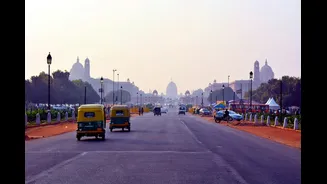


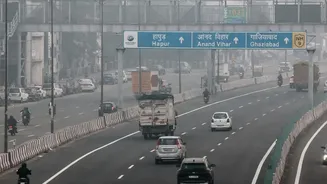
As Delhi's air quality often dips into hazardous territory, the term 'Severe Plus' appears. This isn't just a label; it’s a critical trigger for a series of emergency measures that directly impact daily life across the National Capital Region.
Decoding the Air Quality Index (AQI)
The Air
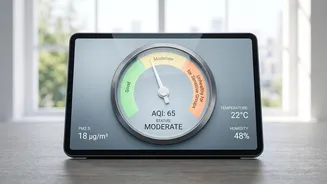
Quality Index, or AQI, is a simple number used to communicate how polluted the air currently is. In India, it's broken down into six categories: 'Good' (0-50), 'Satisfactory' (51-100), 'Moderate' (101-200), 'Poor' (201-300), 'Very Poor' (301-400), and 'Severe' (401-450). The category that triggers the most stringent actions is 'Severe Plus', which is activated when the AQI value surpasses 450. This level indicates a public health emergency, as the concentration of tiny, harmful particles known as PM2.5 and PM10 is dangerously high, posing serious health risks even to healthy individuals.
GRAP Stage IV: The Emergency Response
When the AQI is forecast to exceed or actually crosses the 450 mark, the Commission for Air Quality Management (CAQM) invokes Stage IV of the Graded Response Action Plan (GRAP), the highest and most restrictive level. Think of GRAP as a pre-planned set of emergency measures that escalate with worsening air quality. Stages I ('Poor') and II ('Very Poor') involve actions like enforcing pollution norms and mechanised sweeping. Stage III ('Severe') tightens the screws by banning non-essential construction and restricting certain vehicles. Stage IV ('Severe Plus') goes even further, implementing a near-total lockdown on activities that contribute to pollution. These actions are not suggestions; they are mandatory orders for government bodies and the public.
School Closures Become Mandatory
One of the most significant impacts of GRAP Stage IV is on education. Under these rules, state governments in the NCR are directed to close schools and colleges. Physical classes are suspended, and institutions are instructed to shift to online learning. However, exceptions are often made for students in Classes 10 and 12 to allow them to continue preparing for board examinations, though the final decision rests with the state governments. The primary goal is to prevent children, who are especially vulnerable to the harmful effects of polluted air, from being exposed during their commute and time at school.
Halting Outdoor Work and Movement
Under 'Severe Plus' conditions, outdoor life grinds to a halt. All construction and demolition activities are completely banned, including major public projects like highways, flyovers, and pipelines that might have been permitted under lower GRAP stages. The entry of trucks into Delhi is prohibited, with exemptions only for those carrying essential goods or running on cleaner fuels like CNG, LNG, or electric power. Furthermore, authorities can implement an 'odd-even' scheme for private vehicles to reduce traffic. The government also strongly advises the public, especially children, the elderly, and those with existing respiratory or cardiac conditions, to avoid all outdoor activities, including morning walks and sports.
Work_from_Home and Other Measures
To further reduce vehicular emissions, GRAP Stage IV includes provisions for office work. The CAQM advises that 50% of staff in both government and private offices should be allowed to work from home. Beyond traffic and construction, the plan also empowers state governments to consider additional emergency measures, such as closing non_essential commercial activities and markets. These comprehensive restrictions are designed to rapidly bring down pollution levels by targeting its primary sources: vehicular emissions, construction dust, and industrial activity. While disruptive, they are deemed necessary to mitigate a severe public health crisis.