





Prep Your Rig and Recovery Gear
A pro drive starts long before you hit the trail. The first rule of wet-weather off-roading is to expect to get stuck. Your preparation will determine whether it's a minor inconvenience or a day-ending disaster. Before leaving, conduct a thorough check
of your Jeep: fluids (engine oil, coolant, brake fluid), battery terminals, and lights. Most importantly, assemble a robust recovery kit. Essential items include a high-quality tow strap (not a snatch strap for simple pulls), at least two D-ring shackles, a pair of sturdy gloves, and a shovel. For more serious trails, a winch is a game-changer. Also, pack a tyre inflator/deflator and a reliable pressure gauge. Inform someone of your intended route and estimated return time. In remote forests with no mobile signal, this is a non-negotiable safety step.
Master Your Tyre Pressure
Your tyres are the only part of your Jeep touching the ground, and in wet, muddy conditions, their performance is everything. Highway tyre pressure (typically 30-35 PSI) is too high for slippery trails. A high-pressure tyre has a smaller contact patch and will dig into mud rather than floating over it, quickly leading to a loss of traction. 'Airing down'—reducing your tyre pressure—dramatically increases the tyre's footprint. This spreads the vehicle's weight over a larger area, improving grip on soft surfaces like mud and sand. For general rainy forest trails, a starting point of 15-20 PSI is effective. For deep, sloppy mud, you might go even lower. Remember to adjust based on your specific tyres (All-Terrain or Mud-Terrain are best) and vehicle weight. The difference is not subtle; it’s transformative.
Know When to Use 4-High vs. 4-Low
Your Jeep's four-wheel-drive system is more than just an on/off switch. Understanding the difference between 4-High (4H) and 4-Low (4L) is crucial. Engage 4H as soon as you leave the tarmac for the trail. This provides power to all four wheels and is perfect for light-duty trails, slippery dirt roads, and maintaining momentum at moderate speeds. It's your go-to for most of the rainy forest track. However, when you face a serious obstacle—a steep, slippery incline, deep mud pit, or a technical rocky section—it's time for 4L. Shifting into 4L (while stopped or rolling very slowly in neutral) engages a lower gear ratio, multiplying the engine's torque. This gives you maximum power and control at crawling speeds. It allows for precise throttle input, preventing wheel spin and letting the Jeep do the work without straining the engine.
Technique for Mud and Ruts
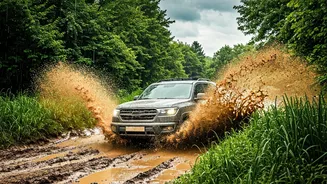
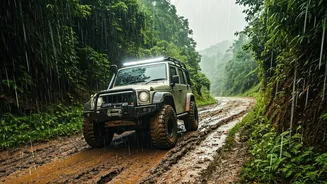
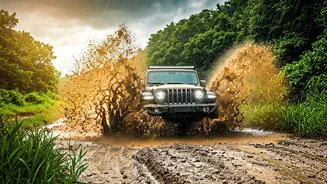
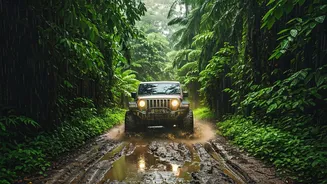
Driving in mud is an art. The key is smooth, steady momentum. Avoid sudden acceleration, hard braking, or sharp steering inputs, as these will break traction instantly. When approaching a mud patch, assess its depth if possible. Select the right gear (often 4L) before entering and maintain a consistent speed. Keep the engine in its power band to avoid bogging down. If the wheels start to spin, ease off the throttle slightly and gently turn the steering wheel left and right. This can help the tyre treads find new grip. If you encounter deep ruts from other vehicles, it's often best to place your tyres on the high ground on either side. If you must drive in the ruts, be prepared for the vehicle to be pulled around and keep steering inputs minimal to avoid fighting the track.
Safely Navigate Water Crossings
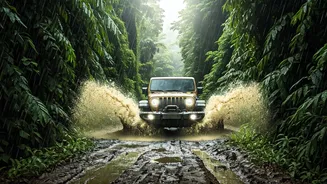
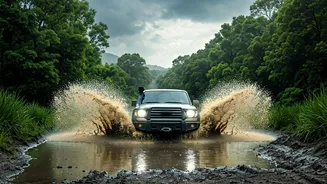
A rain-swollen stream can be one of the most dangerous obstacles. Never cross fast-moving water, and always check the depth before entering. A good rule of thumb is to not attempt a crossing deeper than the bottom of your vehicle's doors. Walk the crossing first if it's safe to do so, checking for hidden rocks or holes. Before entering, identify your entry and exit points. Use 4L and enter the water slowly, creating a steady 'bow wave' in front of your Jeep. This wave creates a depression in the water level around your engine bay, helping to protect vital electronics and the air intake. Maintain a constant speed—not too fast to flood the engine, not too slow to lose momentum. If you stall, do not try to restart the engine, as you risk catastrophic water damage. The safest option is to get recovered by another vehicle.