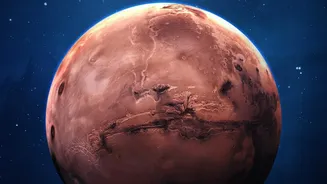


Mars has two tiny, lumpy moons named Phobos and Deimos, and for decades, scientists have debated a fundamental question: where did they come from? The mystery of their origin is a long-standing planetary puzzle, and the debate is heating up.
Meet Mars's Mysterious Moons
Unlike Earth’s
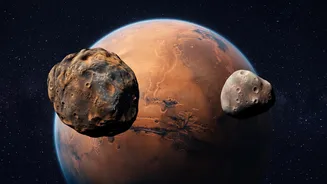
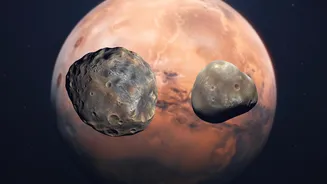
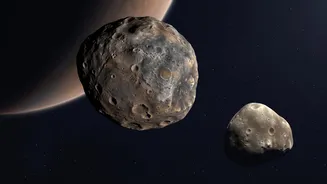
large, spherical Moon, the companions to Mars are small and oddly shaped. Phobos (meaning 'fear') and Deimos ('dread') look more like asteroids than traditional moons. Phobos, the larger of the two, is only about 22 kilometres across and orbits so close to Mars that it circles the planet three times a day. Deimos is smaller and orbits further out. Their irregular shapes and dark, cratered surfaces have led many scientists to believe they are space rocks that wandered too close to Mars and were captured by its gravity.
Theory 1: The Captured Asteroids
For a long time, the leading hypothesis was that Phobos and Deimos were asteroids pulled in from the asteroid belt. This idea is supported by their appearance; they bear a striking resemblance to carbon-rich C-type asteroids common in the outer solar system. However, this theory has a major flaw: their orbits. Captured objects typically have eccentric, tilted orbits. Phobos and Deimos, in contrast, have remarkably circular orbits that lie almost perfectly along Mars's equator. It is very difficult for orbital mechanics models to explain how captured asteroids could have settled into such neat, orderly paths.
Theory 2: The Giant Impact
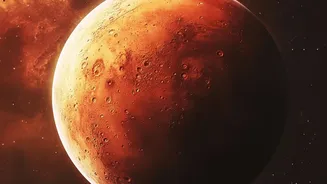
This orbital evidence has given rise to a more dramatic theory: a giant impact. Similar to the leading theory for the formation of Earth's Moon, this hypothesis suggests that a large object—perhaps the size of an asteroid like Vesta—smashed into a young Mars billions of years ago. The collision would have blasted a massive cloud of rock and debris into orbit around the planet. This debris ring then would have gradually coalesced to form Phobos and Deimos. This scenario neatly explains their circular, equatorial orbits. Models suggest the moons would be primarily made of material from Mars itself, a key detail that could be tested.
A Mission to Settle the Debate
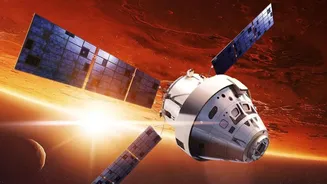
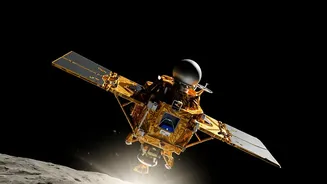
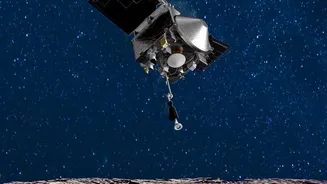
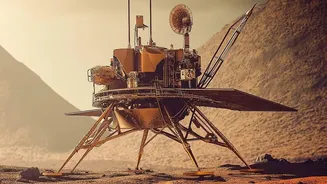
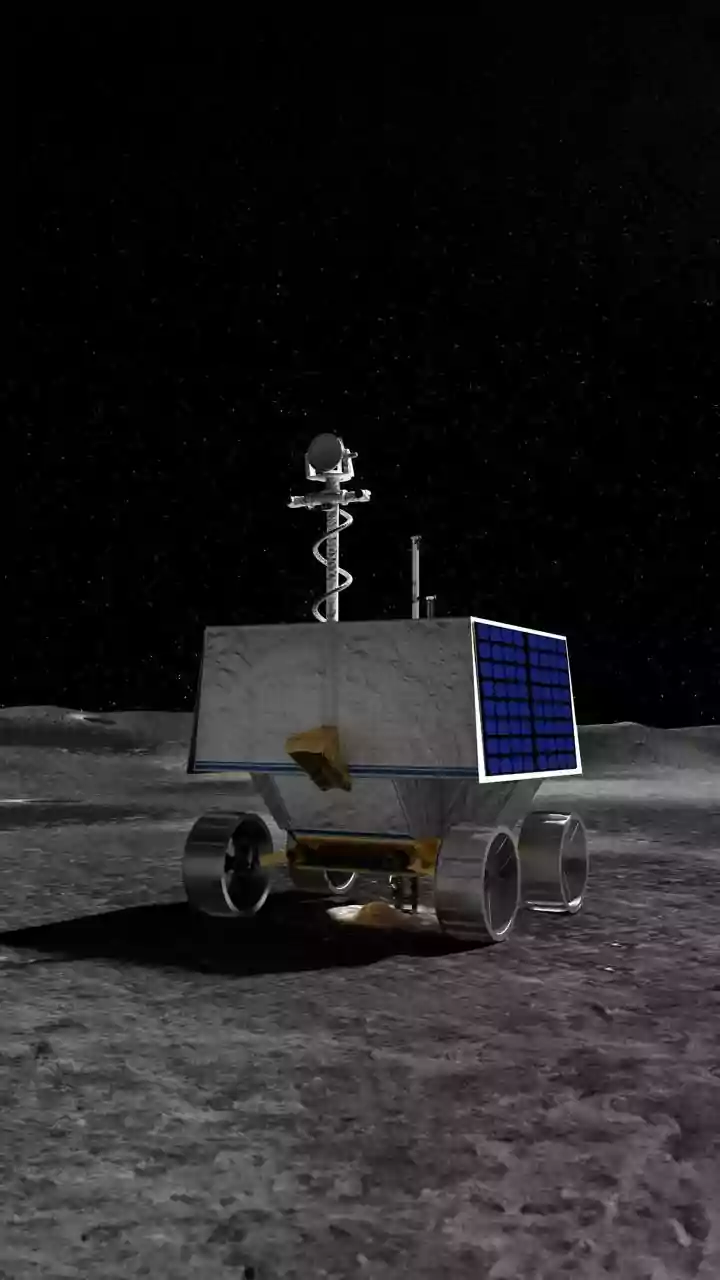
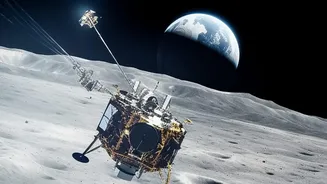
So how do you solve a puzzle like this? You go there and get a piece of it. That is the goal of the Martian Moons eXploration (MMX) mission, led by the Japan Aerospace Exploration Agency (JAXA). Launched in October 2026, the MMX spacecraft is currently on a yearlong journey to Mars. Its prime objective is to land on Phobos, collect at least 10 grams of surface material, and return it to Earth for analysis. This sample will be a game changer. By analyzing its composition, scientists can determine if it matches the makeup of Mars (supporting the impact theory) or if it more closely resembles meteorites from the asteroid belt (which would reignite the capture theory).
What the Sample Could Reveal
If the samples from Phobos are made of the same stuff as Mars, it would provide strong evidence for the giant impact theory. If they are compositionally different, it suggests they came from elsewhere in the solar system. The MMX mission, a collaboration between several international space agencies, is expected to arrive at Mars in August 2027. After surveying both moons, it will perform its daring sample collection in 2029. The precious cargo is scheduled to parachute down in Australia in 2031, finally delivering the clues needed to write the origin story of these enigmatic moons.