



A Familiar, Toxic Haze Returns
As of mid-November 2026, Delhi's Air Quality Index (AQI) has consistently remained in the 'Very Poor' and 'Severe' categories, with some monitoring stations recording hazardous levels. In response to the dangerously high concentration of pollutants, the Commission
for Air Quality Management (CAQM) invoked Stage III of the Graded Response Action Plan (GRAP). A key part of this directive involves instructing all government and private schools in Delhi and surrounding NCR districts to shift to a hybrid learning model for students up to Class 5, reducing their exposure to the toxic air. This measure, while aimed at protecting children's vulnerable lungs, forces them back into a familiar state of confinement, echoing the recent disruptions of the pandemic.
From Classrooms to Screens, Again
The switch to online classes is no longer a novelty for Delhi's children. It has become a recurring feature of their academic year, triggered by public health crises of different kinds. This repeated disruption to their daily routines, social lives, and learning environments is taking a significant toll. The shift forces children into a more sedentary lifestyle, replacing hours of play and peer interaction with hours of screen time. Experts and parents alike are raising alarms, noting that this cycle of indoor confinement, implemented to safeguard physical health, is creating a host of secondary problems affecting children's mental and emotional development.
The Invisible Toll on Young Minds
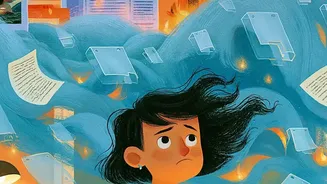
The primary concern emerging from this situation is a sharp rise in anxiety among children. Psychologists and mental health experts warn that being confined indoors leads to a significant reduction in physical activity, which is crucial for both physical and mental well-being. The lack of face-to-face interaction with peers can lead to feelings of isolation and loneliness. Furthermore, the increased reliance on screens for both education and entertainment is linked to eye strain, headaches, sleep disturbances, and behavioural changes like irritability and poor concentration. A survey conducted in late 2025 and early 2026 by the Chintan Environmental Research and Action Group found that nearly 70% of children in Delhi-NCR felt stressed or worried due to poor air quality, with many reporting feelings of anxiety and fear. This 'pollution anxiety' is a growing phenomenon, where the constant awareness of the toxic environment outside fosters a sense of helplessness and worry.
A 'No-Win' Dilemma for Parents
Parents across the national capital find themselves caught in an impossible situation. On one hand, sending their children to school means exposing them to air that can cause severe respiratory issues and stunt lung development. On the other, keeping them home means contending with the negative consequences of social isolation and excessive screen time. Many parents report their children exhibiting behavioural changes, from increased tantrums and stubbornness to sadness and a lack of interest in activities they once enjoyed. They are forced to become monitors of their children's online education while simultaneously managing their own work and the household's well-being, creating a stressful environment for the entire family.
More Than a Temporary Fix Is Needed
While shifting to online classes is a necessary emergency measure, its repeated use highlights a larger failure to address the root cause of the problem. Relying on school closures as a primary tool to combat pollution's effects is not a sustainable long-term strategy. It places the burden of a systemic environmental failure squarely on the shoulders of children, robbing them of their right to a normal, healthy childhood that includes clean air, outdoor play, and in-person socialisation. Experts argue that the conversation needs to move beyond temporary fixes and towards aggressive, year-round policies that tackle pollution at its source, ensuring that a child's education and mental health are no longer casualties of the city's toxic air.