


Understanding Super-Earths
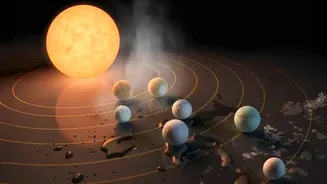
So, what exactly is a super-Earth? The term refers to a planet's size and mass—larger than Earth but smaller than ice giants like Neptune. They can be made of rock, gas, or a combination, and they are surprisingly common throughout our galaxy. This category
of planet is a primary target for astronomers because it represents a missing link in our understanding of planetary formation; our own solar system contains small rocky planets and large gas giants, but nothing in between. These worlds could be anything from scorching lava planets to icy water worlds, making them fascinating subjects for study.
Webb’s Powerful Infrared Gaze
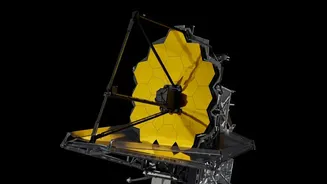
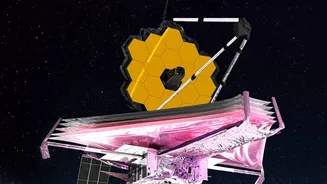
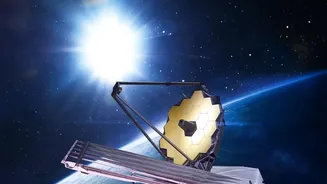
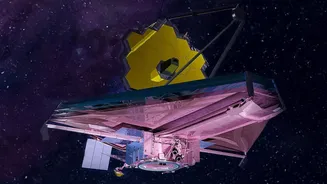
The JWST’s magic lies in its ability to see the universe in infrared light, which is invisible to the human eye. When a planet passes in front of its host star from our perspective, a tiny amount of starlight filters through the planet's atmosphere. Different gases in that atmosphere absorb specific wavelengths, or colours, of this infrared light. By analysing the 'missing' colours with instruments like the Near-Infrared Spectrograph (NIRSpec) and the Mid-Infrared Instrument (MIRI), scientists can decipher the chemical fingerprint of the planet's atmosphere. This technique, called transmission spectroscopy, allows us to study the composition of worlds light-years away.
A Tale of Two Worlds
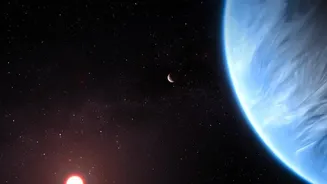
Recent discoveries highlight the incredible power of this technology. Take 55 Cancri e, a super-Earth located 41 light-years away. It orbits its star so closely that its surface is likely a bubbling ocean of magma. Scientists had long debated whether a planet so hot could even retain an atmosphere. JWST data provided the best evidence to date that it does, likely a thick one rich in carbon dioxide or carbon monoxide that is being replenished by gases from the molten surface. The telescope detected this by measuring a surface temperature cooler than expected, suggesting an atmosphere was distributing heat from the scorching dayside to the dark nightside. In contrast, another super-Earth named LHS 1140 b presents a different picture. Orbiting in its star's habitable zone, this planet is cooler and could be an ocean or ice world. JWST observations have ruled out a hydrogen-dominated atmosphere, suggesting a denser one, possibly with nitrogen and water vapour. This makes it one of the most promising candidates for future studies on habitability.
The Search for Answers
Detecting these atmospheres is a monumental step, but it's important to frame the discoveries correctly. Finding carbon dioxide or nitrogen isn't proof of life, but it is a critical piece of the puzzle. These findings help scientists build a census of what kinds of atmospheres exist and under what conditions they can survive. By studying a variety of worlds—from the hellishly hot like 55 Cancri e to the more temperate like LHS 1140 b—researchers can refine their models of planet formation and evolution. Some planets, like LHS 3844 b, have been found by Webb to be bare rock with no significant atmosphere at all, providing an important counterpoint. Each detection, or lack thereof, helps us understand the ingredients necessary for a planet to potentially support life.