



2001: A Space Odyssey (1968)
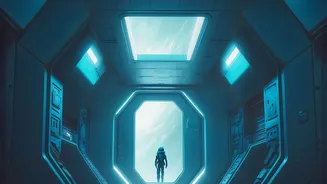
Stanley Kubrick’s masterpiece is less a movie and more a cinematic event. Released long before the dawn of computer-generated imagery, its visual grandeur was achieved through breathtakingly ambitious practical effects. From the iconic, balletic docking
sequence set to classical music to the mind-bending Stargate sequence, every frame is a work of art. The film’s pioneering techniques, like front projection and meticulous model work, created a vision of space travel that felt profoundly real and awe-inspiring. Seeing it on a massive screen allows you to appreciate the sheer audacity and artistry of its construction, transforming a viewing into a near-meditative experience about humanity's place among the stars. It set the benchmark for what a sci-fi epic could be.
Blade Runner 2049 (2017)
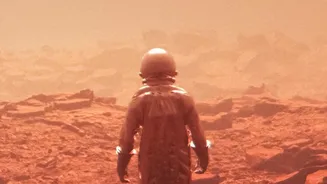
While the original 'Blade Runner' established a legendary aesthetic, Denis Villeneuve’s sequel expands it into a visually staggering epic. Cinematographer Roger Deakins, who won an Oscar for his work here, paints a world in sweeping, atmospheric tableaus. The visuals are defined by their use of colour and stark, geometric shapes, from the hazy, orange-dusted ruins of Las Vegas to the oppressive, brutalist architecture of future Los Angeles. Every shot is composed with painterly precision, creating a tangible sense of a desolate, beautiful, and decaying world. The sheer scale of the cityscapes and landscapes is overwhelming in the best way possible, making the giant screen the only way to truly absorb the rich detail and oppressive beauty Villeneuve and Deakins crafted.
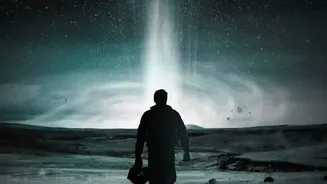
Interstellar (2014)
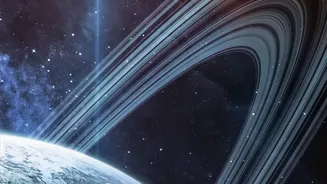
Christopher Nolan is known for his commitment to in-camera effects and large-format filmmaking, and 'Interstellar' is arguably his most spectacular showcase. This is a film that balances human emotion with the terrifying, humbling vastness of space. Its depiction of a wormhole and the black hole, Gargantua, wasn't just movie magic; it was based on theoretical equations from physicist Kip Thorne, resulting in scientifically plausible and visually groundbreaking imagery. The immense tidal waves on Miller's planet, the silent emptiness of the cosmos, and the journey through the tesseract are sequences designed to overwhelm the senses. On a big screen, accompanied by Hans Zimmer’s organ-heavy score, 'Interstellar' becomes an intense, visceral journey into the unknown that makes you feel infinitesimally small against the backdrop of the universe.
Dune (2021)
Denis Villeneuve appears on this list again for his masterful adaptation of Frank Herbert’s famously dense novel. 'Dune' is a film defined by its monumental scale. Everything from the colossal sandworms of Arrakis to the city-sized spaceships is designed to communicate a sense of overwhelming size and power. The production design blends brutalist architecture with ancient cultural influences, creating a world that feels both alien and deeply lived-in. Cinematographer Greig Fraser captures the harsh, beautiful light of the desert planet with a stark realism that makes the sand, spice, and sky feel tangible. It’s a film where the environment is as much a character as any person, and its sheer, awesome scale can only be properly appreciated when it fills your entire field of vision.
Gravity (2013)
Few films have captured the terrifying and beautiful reality of being in orbit quite like Alfonso Cuarón’s 'Gravity'. It’s an exercise in immersive filmmaking, using long, fluid takes and a seamless blend of live-action and CGI to place you directly in the spacesuit of Sandra Bullock’s stranded astronaut. The film was lauded for its groundbreaking use of 3D, which wasn't a gimmick but a tool to create a genuine sense of depth, distance, and disorientation. Watching debris tear through the International Space Station or seeing Earth hang silently in the void becomes an intensely personal and claustrophobic experience. On a large screen, the film's technical wizardry and masterful sound design combine to create a uniquely heart-pounding and breathtaking survival thriller that truly makes you feel adrift in the infinite.