

Smarter Satellites and Sharper Insights
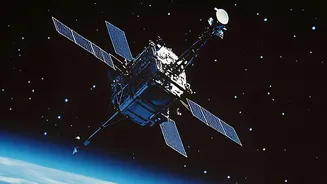
One of the most significant impacts of AI is in making sense of the colossal amount of data beamed back to Earth from satellites. India operates a vast fleet of Earth observation satellites that monitor everything from weather patterns and crop health
to urban expansion and forest cover. Manually analysing these petabytes of images is an impossible task. AI and machine learning algorithms are now trained to sift through this data at incredible speeds, identifying patterns and changes that the human eye might miss. This enables faster and more accurate predictions for disaster management, like early warnings for floods or cyclones, and provides critical intelligence for urban planning and precision agriculture. By automating the analysis, AI turns raw satellite imagery into actionable intelligence for governance and industry.
Autonomous Missions and Enhanced Safety
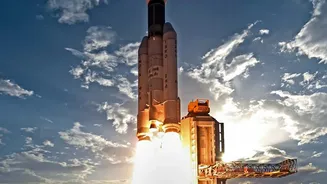
For missions venturing far from Earth, real-time human control is not feasible due to communication delays. This is where AI-driven autonomy becomes critical. ISRO is developing AI solutions for spacecraft that can navigate, monitor their own health, and make independent decisions. This was evident in the Chandrayaan missions, where AI-assisted systems helped in identifying a safe landing site on the Moon's surface, avoiding hazards autonomously. Looking ahead, for the ambitious Gaganyaan human spaceflight mission, AI will be a core component. It will be used in the 'Crew Escape System' to manage threats and ensure astronaut safety, and an AI-enabled humanoid, Vyommitra, is slated to fly on an uncrewed test flight to simulate human functions and interact with the spacecraft's life support systems.
Optimising from Launch to Orbit
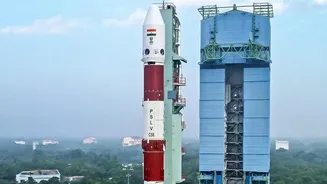
AI's role begins long before a mission leaves the ground. It is increasingly used in designing and optimising mission trajectories for launch vehicles and spacecraft. Furthermore, AI algorithms can predict the health of a satellite or rocket by analysing telemetry data, spotting anomalies that could signal a future failure. As space becomes more crowded, managing traffic and avoiding collisions with debris is a growing concern. AI is perfectly suited to this challenge, helping to monitor objects in orbit and even enabling future satellites to communicate and manoeuvre independently to prevent accidents, ensuring the long-term sustainability of space operations.
The Rise of Private Innovation
The integration of AI into India's space sector isn't limited to ISRO. A burgeoning ecosystem of private startups is leveraging AI to create innovative products and services. Companies like Digantara are using AI to build space surveillance networks for tracking orbital objects. Others, such as Pixxel, use AI to process hyperspectral satellite imagery, providing unique insights for agriculture, energy, and environmental monitoring. There are even ambitious plans from startups like Sarvam AI and Pixxel to launch orbital data centres, which would process vast amounts of data in space itself using powerful AI models. This private-sector push, supported by government initiatives like IN-SPACe, is creating a dynamic environment for innovation, positioning India to become a major player in the global space economy.