





A System in Miniature
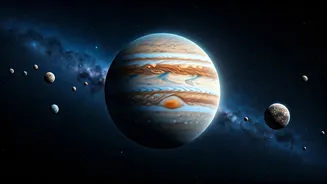
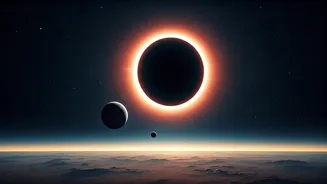
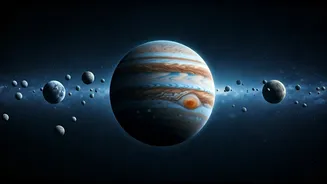
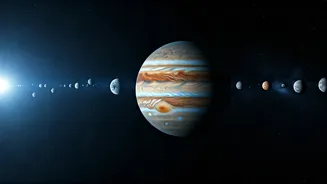
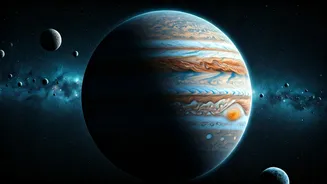
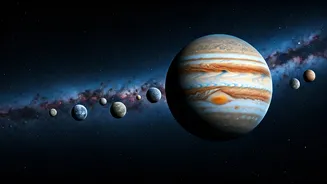
The comparison of the Jovian system to a mini solar system is a fitting one. Just as the Sun’s gravity dictates the paths of planets like Earth and Mars, Jupiter’s gravitational field commands its own complex satellite system. This system is so extensive
that the latest official count stands at 115 known moons as of April 2026, a figure that has steadily climbed from 95 in early 2023 as our detection methods improve. These moons aren't just a homogenous group of rocks; they are diverse worlds. They range from planet-sized spheres with their own geology to small, irregularly shaped objects that were likely captured asteroids. Together, they form a dynamic system that offers scientists a unique laboratory for understanding how planetary systems form and evolve.
The Four Royal Courtiers
At the core of Jupiter's system are the four Galilean moons, discovered by Galileo Galilei in 1610. These are planetary-mass moons, so large they would be considered planets if they orbited the Sun directly. The largest, Ganymede, is bigger than the planet Mercury and is the only moon in our solar system known to have its own magnetic field. Next is Callisto, a heavily cratered, ancient world that may hide a subsurface ocean. Then there is Europa, with its smooth, icy shell fractured by mysterious lines, believed to cover a vast liquid water ocean that could potentially harbour life. Finally, there's Io, the most volcanically active body in the entire solar system, its surface constantly reshaped by eruptions of sulfur. The incredible activity on Io and the potential ocean on Europa are powered by tidal heating, an internal friction generated by the relentless gravitational push and pull from Jupiter and the other moons.
A Swarm of Irregular Followers
Beyond the four giants and a handful of smaller, inner moons lies a chaotic swarm of 'irregular' satellites. Unlike the Galilean moons, which formed from a disk of gas and dust around a young Jupiter, these irregulars are thought to be asteroids and comets captured by the planet’s powerful gravity millions of years ago. They are typically small, just a few kilometres in diameter, and follow distant, eccentric, and highly inclined orbits. Many even orbit in a retrograde direction, meaning they travel opposite to Jupiter's rotation—a clear sign they were not born with the planet. These captured worlds often cluster into 'families' with similar orbits, suggesting they are fragments of larger bodies that shattered upon capture or in a later collision.
The Hunt for New Moons
The number of Jupiter's known moons has exploded in the 21st century, jumping from a handful to over 100. This is thanks to powerful new telescopes and sensitive digital imaging technology that can spot faint, tiny objects moving against the background stars. Astronomers find these moons by taking a series of images of a patch of sky and looking for points of light that move in a way that suggests they are bound to Jupiter's gravity. Confirming a new moon is a painstaking process, often requiring a year or more of follow-up observations to precisely map its orbit. Given the ongoing surveys and improving technology, some astronomers estimate that Jupiter could have around 600 moons with diameters of about 800 meters or more, most of which remain undiscovered.