


The Galaxy's Heartbeat
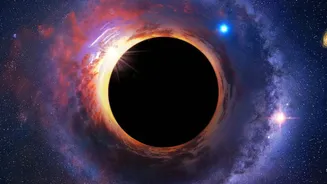
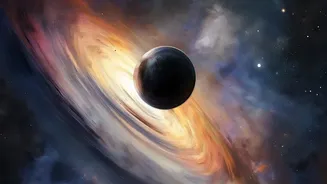
At the center of almost every massive galaxy, including our own Milky Way, lurks a supermassive black hole (SMBH)—an object with millions to billions of times the mass of our sun. For a long time, these cosmic giants were seen as relatively passive anchors.
However, a growing body of evidence, much of it collected over the last decade, paints a far more dynamic picture. It suggests these black holes are not just residents of their galaxies; they are powerful engines that actively shape their evolution. This concept of co-evolution, where the galaxy and its central black hole grow and change together, has become a cornerstone of modern astrophysics. The key question has been how this connection works across billions of years and unimaginable distances.
A Decade of Watching the Skies
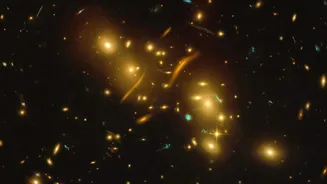
Answering that question required patience and powerful tools. Astronomers have used long-term surveys, effectively watching patches of the sky for years, to track how galaxies change over cosmic time. By observing galaxies at different distances, they are essentially looking back into the past, piecing together a timeline of galactic life. These projects, like the Sloan Digital Sky Survey and the COSMOS surveys, have gathered multi-wavelength data on hundreds of thousands of galaxies. Recent analyses of this wealth of data, some compiled over ten years or more, are allowing scientists to connect a black hole's activity directly to the state of its entire host galaxy. This long-term tracking has been crucial in moving from theoretical models to observational proof.
The Galactic Feedback Mechanism
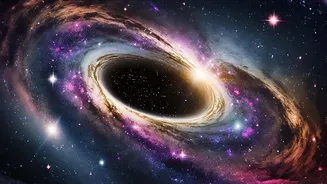
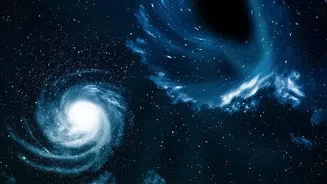
The primary way a black hole influences its galaxy is through a process called 'Active Galactic Nucleus (AGN) feedback'. When a black hole actively feeds on surrounding gas and dust, the material heats up and radiates incredible amounts of energy, creating a brilliant quasar. This process can also launch powerful winds and jets of material at near-light speeds. This outflow of energy and matter acts like a galactic thermostat. It can heat up or blow away the cold gas clouds that are the necessary fuel for star formation. In effect, an active black hole can shut down, or 'quench', star birth across its entire galaxy, causing it to transition from a vibrant, star-forming spiral to a 'red and dead' elliptical galaxy populated by old stars.
A Complicated Relationship
However, the link isn't always so simple. The relationship is more of a complex cycle than a straightforward off-switch. While powerful AGN feedback can halt star formation, some studies show that the jets and outflows can also compress gas in certain areas, triggering new bursts of star birth. Furthermore, recent simulations and observations from telescopes like the James Webb Space Telescope are challenging the idea that galaxies and their black holes always grow in perfect lockstep. Some studies have found black holes that are astonishingly massive compared to their host galaxies, suggesting they grew much more rapidly. This implies that the 'rules' of co-evolution might be more flexible than previously believed, with galaxy mergers and the larger cosmic environment also playing key roles.
Why This Cosmic Story Matters
Understanding this cosmic dance between black holes and galaxies is fundamental to understanding our own place in the universe. It helps explain the diverse array of galaxies we see today—why some are brilliant spirals teeming with new stars and others are quiet ellipticals. The processes that quench star formation in distant galaxies are the same ones that have shaped the Milky Way, whose own central black hole, Sagittarius A*, is currently in a quiet phase. By studying these systems over cosmic history, from the early universe to today, scientists are building a more complete picture of how the universe's grand structures came to be, powered by the immense gravitational forces at their very hearts.