



First, Let’s Define Our Terms
Before we dive into the Venusian twilight zone, let’s quickly refresh two basic concepts: a day and a year. For any planet, a 'year' is the time it takes to complete one full orbit around its star. For Earth, that’s roughly 365 days. A 'day' is the time it takes for the planet to complete one full rotation
on its own axis. For Earth, that’s about 24 hours. We take this rhythm for granted: many short days fit neatly inside one long year. This simple, intuitive pattern governs our seasons, our calendars, and our daily lives. But the universe has no obligation to stick to our script. Venus is the ultimate proof of this, turning our familiar understanding of time completely on its head.
The Bizarre Venusian Calendar
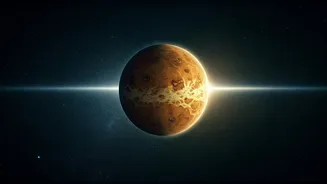
Here’s where the numbers get weird. Venus cruises around the Sun faster than you might think, completing one full orbit—a Venusian year—in about 225 Earth days. By contrast, it spins on its axis at a glacial pace. A single sidereal day on Venus, meaning one full 360-degree rotation, takes approximately 243 Earth days. Let that sink in. Its day (243 Earth days) is longer than its year (225 Earth days). If you could stand on the surface of Venus, the planet would complete its entire journey around the Sun before it even finished a single spin. This makes Venus the only planet in our solar system with a day longer than its year. It’s a place where the basic units of time feel completely out of order.
A Planet Spinning the Wrong Way
To add another layer of strangeness, Venus spins backwards. Nearly every planet in our solar system, including Earth, has a prograde rotation, meaning they spin in the same direction as they orbit the Sun (counter-clockwise if you’re looking down from above the North Pole). This is why our sun rises in the east and sets in the west. Venus, however, has a retrograde rotation. It spins clockwise. This means that if you were on Venus (and somehow survived the crushing pressure and hellish 465°C temperatures), you would see the sun rise in the west and set in the east. This backward, sluggish rotation is a key piece of the puzzle in understanding its bizarre day-year relationship.
Why is Venus So Slow and Backwards?
Scientists don't have a single, definitive answer, but there are a few leading theories. One popular hypothesis suggests that in its distant past, Venus was struck by a massive asteroid or planetesimal. A powerful enough collision could have dramatically altered its rotational speed, slowing it to a crawl or even knocking it over and causing it to spin in the opposite direction. Another compelling theory points to Venus's incredibly thick atmosphere. The planet’s atmosphere is about 90 times denser than Earth’s, creating immense pressure. Scientists believe that over billions of years, powerful atmospheric tides could have created friction with the planet's surface. This constant drag may have gradually slowed Venus’s original, faster rotation and eventually caused it to reverse. It's possible that a combination of these factors led to the strange state we see today.
A Sunrise Lasting Months
The combination of its slow, retrograde spin and its orbit creates yet another temporal oddity: the solar day. While its rotational day is 243 Earth days, the time from one sunrise to the next on Venus is 'only' about 117 Earth days. This is because as Venus is slowly spinning backward, it’s also moving along its orbit around the sun. The two motions combine to create a much shorter (though still incredibly long) sunrise-to-sunrise cycle. This means that if you were living on Venus, you would experience about two 'days' (in the sunrise-to-sunrise sense) for every 'year' (one trip around the sun). Each period of daylight would last for nearly two Earth months, followed by a night of equal length. It’s a world of extreme timescales, governed by a cosmic dance completely alien to our own.