



A New Polygon in the Solar System
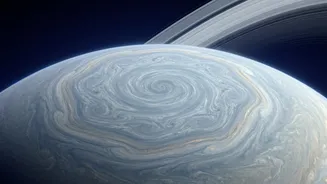
For decades, astronomers have been fascinated by Saturn's north pole, which is famously encircled by a persistent, six-sided jet stream known as 'the hexagon'. This feature has been a stable fixture for over 40 years. Now, Hubble has spotted a new geometric
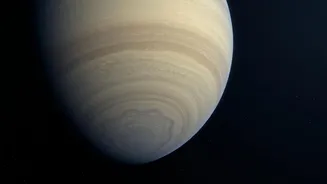
marvel at the opposite end of the planet: a developing 10-sided feature, or decagon, in the southern hemisphere. This is the first time a large, regular-sided atmospheric pattern has ever been observed on Saturn's south pole. The discovery, detailed in the journal Science Advances, offers scientists a rare opportunity to watch a giant planetary weather system as it forms and evolves.
How The Discovery Was Made
The discovery was a collaborative effort, kickstarted by keen-eyed amateur astronomers. In 2024, observers noticed a faint, undulating band near the south pole in ground-based images. By 2025, the hints of a decagonal structure grew stronger, prompting researchers to use the powerful Hubble Space Telescope for a closer look. The space telescope's sharp vision, free from the blurring effects of Earth's atmosphere, confirmed the wave's existence. By analysing archival data from Hubble's Outer Planet Atmospheres Legacy (OPAL) program, which has been monitoring the outer planets for over a decade, scientists were able to trace the feature's origins back to at least 2023, when it was much less defined.
What Makes This Wave 'Unusual'?
While it bears a family resemblance to its northern hexagonal cousin, the new southern decagon has distinct characteristics. Unlike the nearly stationary hexagon, the decagon appears to be migrating slowly. Furthermore, it seems to have formed very recently. NASA's Cassini spacecraft, which orbited Saturn from 2004 to 2017, saw no evidence of such a long-lived structure at the south pole. This raises a key question for scientists: why has this massive pattern formed now? Observations show the wave isn't just a surface-level cloud pattern; it extends deep into multiple layers of Saturn's atmosphere, indicating a significant and powerful atmospheric structure.
The Search for an Explanation
The sudden appearance of the decagon is a puzzle scientists are eager to solve. One theory is that a powerful storm or vortex may have disrupted the jet stream, triggering the formation of the persistent wave pattern. Researchers noted that a compact vortex, first seen in 2023, darkened significantly right before the decagon became more prominent, suggesting a possible link. The wave itself is part of a powerful jet stream, and scientists believe it could be a type of atmospheric phenomenon known as a Rossby wave, where rotating fluids are forced into stable geometric shapes. However, its recent and rapid formation makes it a unique case study.
A Front-Row Seat to Planetary Weather
This discovery highlights the dynamic and ever-changing nature of planets we often think of as static. It also underscores the enduring value of long-term observation programs like Hubble's OPAL project. Without years of consistent data, subtle changes like the birth of this decagon could easily be missed. For now, the southern decagon serves as a natural laboratory for understanding how giant atmospheric waves and jet streams behave on gas giants. Scientists will continue to monitor the feature with Hubble and other telescopes, watching to see if it stabilises into a long-lasting pattern like the northern hexagon or if it eventually dissipates, offering more clues about the complex physics governing Saturn's atmosphere.