

A New Era: The Artemis Base Camp
For the first time since the Apollo missions, humanity is planning a long-term stay on the lunar surface. The goal of the Artemis program is to establish a sustainable human presence on the Moon, starting with a 'base camp' near the resource-rich South
Pole. This isn't about short visits; it's about creating a blueprint for living and working on other celestial bodies. But before we can build habitats, we need to understand the environment. To do this, NASA has selected a suite of crucial scientific investigations to deploy on the lunar surface. These initial studies are designed to answer fundamental questions about the Moon's environment, resources, and how we can survive there—knowledge that is essential for our next giant leap to Mars.
LEMS: The Moon’s First Environmental Monitor
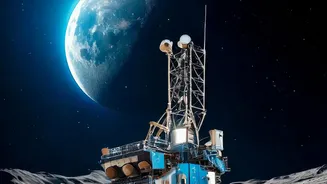
One of the first and most critical payloads is the Lunar Environment Monitoring Station, or LEMS. Think of it as the first long-term weather and hazard station for the Moon. This autonomous suite of instruments will operate for at least two years, collecting vital data on the lunar environment. It will use a seismometer to listen for 'moonquakes' to understand the stability of the ground we plan to build on. It will also monitor the strange dust and volatile gases that drift across the surface and track the constant rain of micrometeoroids. For future Mars explorers, this is invaluable. Mars has a thin atmosphere, but the Moon has virtually none, making it a perfect, unfiltered laboratory to study space radiation and seismic activity—hazards astronauts on the Red Planet will also face.
LEAF: Can We Farm on the Moon?
A long-term presence in space depends on one thing above all else: food. The Lunar Effects on Agricultural Flora (LEAF) experiment tackles this head-on. It will be the first-ever attempt to grow plants on the lunar surface, observing their growth, photosynthesis, and stress responses in the Moon's partial gravity and intense radiation environment. The experiment will use species like Brassica rapa (related to cabbage) and the fast-growing duckweed inside a specially designed chamber. Learning to cultivate crops on the Moon is a game-changer. If we can successfully grow plants that provide food, oxygen, and water recycling, we can reduce our reliance on costly supply missions from Earth. This is a direct dress rehearsal for Mars, where the ability to grow food will be absolutely essential for sustaining a human outpost so far from home.
LDA: The Critical Hunt for Lunar Water
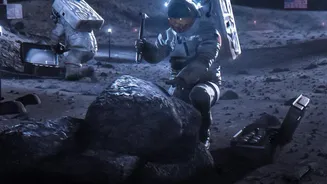
The other critical resource for survival is water. At the Moon's poles, scientists believe vast quantities of water ice are trapped in permanently shadowed craters. The Lunar Dielectric Analyzer (LDA) is a handheld tool designed to find it. Astronauts will use the LDA to measure how the lunar soil, or regolith, responds to an electric field. Different materials, like dry dust versus water ice, have different dielectric properties, so the LDA can effectively 'see' beneath the surface and map out potential frost or ice deposits. Finding and learning how to extract this water is a top priority for Artemis. Lunar water can be purified for drinking, used for growing plants, and even split into hydrogen and oxygen to create breathable air and rocket fuel. Mastering these resource-hunting techniques on the Moon will give future Mars crews the tools and experience they need to find and exploit similar ice deposits on the Red Planet.
Proving Ground for the Red Planet
Every experiment planned for the Moon has a clear line to Mars. Each challenge overcome on the lunar surface makes a Mars mission more feasible. By studying the Moon's geology and seismic jitters with LEMS, we learn how to build safer habitats on other planets. By proving we can grow crops with LEAF, we take a massive step toward self-sufficiency for a Mars colony. By developing techniques to find water with LDA, we unlock the most vital resource for survival and fuel in deep space. The Artemis program is more than a return to the Moon; it's a full-scale test run. It’s a chance to build the 'interplanetary survival guide' that will allow the first humans to safely set foot on Mars and begin humanity’s journey as a multi-planetary species.