






Sharper Predictions, Faster Models
For decades, scientists have relied on complex General Circulation Models (GCMs) to forecast future climate scenarios. While powerful, these models are computationally expensive and can struggle with regional accuracy. AI, particularly machine learning
and deep learning, is changing the game. By processing vast datasets from satellites, ground sensors, and historical records, AI can identify intricate patterns that traditional models might miss. This allows for the creation of hybrid models that are not only faster but also more precise in predicting local climate variations, such as extreme rainfall or sea-level changes. These AI-enhanced systems can generate high-resolution simulations, giving policymakers a much clearer picture of potential climate risks at a regional level.
From Forecasts to Early Warnings
One of the most immediate impacts of AI is its ability to improve early warning systems for extreme weather events. Deep learning models, trained on decades of weather data, can now outperform traditional methods in forecasting phenomena like cyclones, floods, and droughts. For instance, AI algorithms can track shifting rainfall patterns to better predict floods or analyze ocean data to improve forecasts of sea-level changes along coastlines. In parts of Africa, AI is being used in UN-backed projects to help vulnerable communities better plan for and adapt to climate impacts by providing more accurate weather predictions. This improved forecasting capability is crucial for disaster preparedness, enabling authorities to take proactive measures that can save lives and reduce economic damage.
An Eye in the Sky on Deforestation
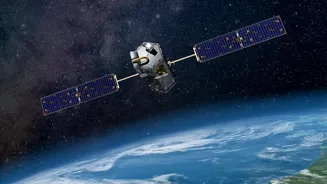
Protecting the world's forests is critical for capturing carbon, but monitoring vast and remote areas has always been a challenge. AI, combined with high-resolution satellite imagery, is providing a solution. Algorithms can now analyze satellite photos with incredible speed and accuracy, identifying areas of deforestation almost in real-time. This technology can distinguish between permanent deforestation and temporary tree cover loss, providing crucial data for conservation efforts and carbon markets. Companies and research institutions are using AI to map the carbon storage of forests, helping to verify the climate benefits of conservation projects and ensure supply chains are free from deforestation.
Discovering the Materials of a Green Future
Beyond monitoring and prediction, AI is actively helping to discover solutions. Generative AI platforms are being used to accelerate the search for new, sustainable materials. For example, AI can design and test molecular structures for everything from more efficient solar panels and better batteries to greener herbicides for agriculture. By simulating thousands of possibilities digitally, AI dramatically reduces the time and cost of laboratory experiments, speeding up the discovery-to-deployment pipeline for clean technologies. This application shows how AI is not just a tool for analysis but also a partner in innovation, helping to build the physical components of a low-carbon economy.
The Energy Paradox
Despite its immense potential, the rise of AI in climate research is not without its challenges. The primary concern is the significant energy consumption of the powerful data centers required to train and run complex AI models. If this energy comes from fossil fuels, AI could inadvertently contribute to the very problem it is trying to solve. There is a growing awareness of AI's carbon footprint, and researchers are working on developing more energy-efficient models and advocating for data centers to be powered by renewable energy. Ensuring that the deployment of AI is sustainable is crucial to maximizing its positive impact on the climate.