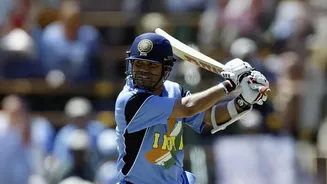








The Context of a Resurgent Team
Heading into the 2003 World Cup in South Africa, the Indian team was talented but not considered the formidable force it is today. Led by Sourav Ganguly, it was a side blending senior experience with explosive new talent. Yet, after a shaky start, including
a comprehensive loss to Australia, the pressure mounted. In this environment, Tendulkar, already a global icon, shouldered the immense weight of a nation's hopes. He became the calm at the centre of the storm, the experienced head that guided the team's fortunes. His consistent brilliance provided the foundation upon which India built its campaign, transforming a team of contenders into a dominant force that marched all the way to the final.
A Torrent of Record-Breaking Runs
The sheer weight of runs Sachin Tendulkar scored is the first pillar of his 2003 legend. He amassed a staggering 673 runs in 11 matches, a record for a single World Cup edition that would stand for 20 years. This was not just a case of one or two big scores; it was a display of relentless consistency. He scored one century and six half-centuries, meaning he passed fifty in more than half of his innings. He scored runs against every opponent, in different conditions, and at various stages of the game. He started with a fifty against the Netherlands, hit a glorious 152 against Namibia, and played crucial knocks against England and Sri Lanka, including a 97. This relentless accumulation of runs showcased a batsman at the absolute zenith of his powers.
The Unforgettable Masterpiece at Centurion
If one innings defined the entire campaign, it was his 98 off just 75 balls against Pakistan. Chasing a challenging 274 against a legendary pace attack of Wasim Akram, Waqar Younis, and Shoaib Akhtar, Tendulkar produced an innings for the ages. The first over from Akhtar became iconic, featuring an audacious upper-cut for six over third man that is still replayed endlessly. It was a statement of intent that immediately put the opposition on the back foot. He attacked all three premier bowlers with a mixture of sublime timing and controlled aggression, dismantling their aura of invincibility. Though he fell two runs short of a century, battling cramps, he had broken the back of the chase and secured a victory that felt like more than just a group stage win; it was a moment of national catharsis.
Dominance Under Immense Pressure
Beyond the statistics and the single iconic innings, what made the 2003 campaign special was Tendulkar's command over high-pressure situations. The match against Pakistan was the prime example, but his crucial 83 in the semi-final against a surprising Kenya team ensured there would be no upset, guiding India into the final. Throughout the tournament, he absorbed the pressure and converted it into performance. Opposing teams knew that getting Tendulkar out early was their primary objective, yet time and again, he delivered. This ability to not just survive but to dominate when the stakes were highest cemented this campaign as a showcase of his mental fortitude as much as his physical skill.
A Poignant End and an Enduring Legacy
India's dream run came to a halt in the final against a seemingly invincible Australian team. Chasing a mammoth target of 360, Tendulkar was dismissed for just four in the first over, and the chase never recovered. India lost the final by a convincing 125 runs. However, this final heartbreak does little to diminish the spectacle of his tournament. He was deservedly named the Man of the Tournament, a rare honour for a player from the runner-up side. The image of a dejected Tendulkar receiving the award is a poignant footnote to a campaign that was, in every other respect, a story of individual triumph. His performance inspired a generation and set a new benchmark for batting in a World Cup.