
The Goldilocks Zone Revisited
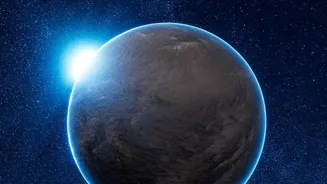
For decades, the search for habitable exoplanets—planets outside our solar system—has been guided by a simple principle: the Goldilocks zone. This is the orbital region around a star where conditions are not too hot and not too cold, but just right for liquid
water to potentially exist on a planet's surface. Water is considered a fundamental prerequisite for life as we know it, so finding a rocky world in this zone has been the first step in identifying promising targets. This concept has served astronomers well, helping to narrow down the billions of planets in our galaxy to a more manageable list of candidates. However, this simple definition is proving to be incomplete. It treats a star like a steady campfire, providing consistent warmth. But we're now learning that stars are far more complex and, in many cases, far more violent hosts.
A Star’s Destructive Power
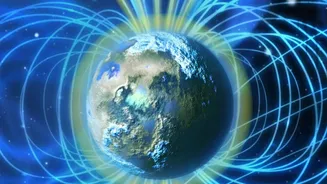
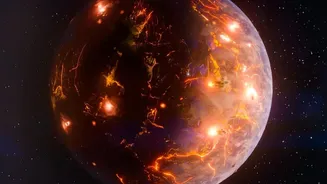
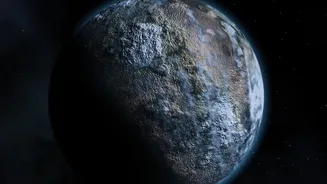
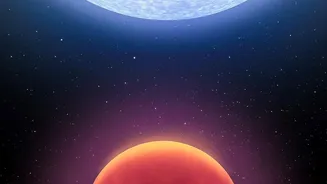
A star is not just a benign source of light and heat; it also bombards its planets with a constant stream of high-energy particles and radiation, including powerful X-rays and ultraviolet (XUV) light. This phenomenon, known as photoevaporation, can act like a relentless blow-dryer aimed at a planet. For worlds orbiting particularly close to their star, or around very active stars like young M-dwarfs, this intense radiation can heat the upper atmosphere, giving gases enough energy to escape the planet's gravitational pull. Over millions of years, this process can strip a planet of its atmosphere entirely, turning a potentially lush world into a barren, airless rock. This means a planet could be in the perfect location for liquid water but still be completely uninhabitable because its protective atmospheric blanket has been blown away into space.
What the JWST Is Actually Seeing
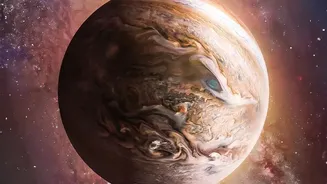
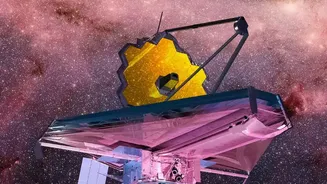
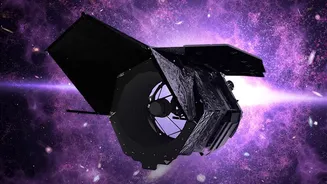
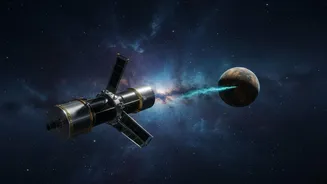
This is where the James Webb Space Telescope changes the game. With its unprecedented sensitivity, JWST can perform a technique called transit spectroscopy. When an exoplanet passes in front of its star from our perspective, a tiny fraction of the starlight filters through the planet's atmosphere. Different gases absorb different wavelengths of light, leaving a unique chemical fingerprint. JWST is powerful enough to read this fingerprint and tell us what an exoplanet's atmosphere is made of. In some dramatic cases, JWST has caught atmospheric stripping in the act. For example, observations of the 'ultra-hot Jupiter' WASP-121b revealed two colossal tails of helium gas escaping the planet and stretching across more than half of its orbit. Seeing this process happen in real-time provides concrete evidence of how severely stellar radiation can erode a world's atmosphere, confirming theories that were previously difficult to prove.
Redefining the Search for Life
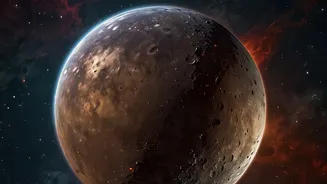
These discoveries are forcing a major refinement of what we consider a 'habitable' planet. It’s no longer just about the address; it’s about the neighborhood. A planet’s ability to hold onto its atmosphere depends heavily on the temperament of its parent star. M-dwarf stars, for example, are the most common type of star in the galaxy and often have rocky planets in their habitable zones. However, they are also known for frequent, intense flares, especially when young, which could make it difficult for nearby planets to sustain an atmosphere. JWST has already studied rocky planets that appear to be bare rock, likely because their atmospheres were stripped away. By identifying which planets are losing their atmospheres, JWST helps astronomers filter out the worlds that are, despite their prime location, poor candidates for life. This refinement makes the search more targeted and efficient.
The Future of Exoplanet Hunting
The era of the JWST marks a shift from simply finding exoplanets to truly characterizing them. We are moving beyond just cataloging worlds to understanding their environments in detail. By analyzing the chemical makeup and escape of planetary atmospheres, scientists can now add another critical layer to their assessment of habitability. Recent studies are even delving into the types of water molecules present, such as the detection of 'semi-heavy water' on one exoplanet, which is less likely to escape than regular water and provides more clues about a planet's atmospheric history. Each observation allows astronomers to build a more nuanced picture, distinguishing the truly promising candidates from those that are merely cosmic mirages. The telescope is not just looking for planets; it is assessing their life-sustaining potential in a way that was never before possible.