



In the heart of Siberia, a remarkable transformation takes place each winter. Lake Baikal, the world's oldest and deepest lake, freezes over, creating a surreal landscape of turquoise ice that seems to glow from within.
A World of Crystal Blue
Imagine standing on a sheet of glass
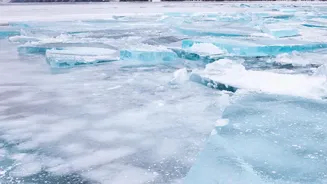
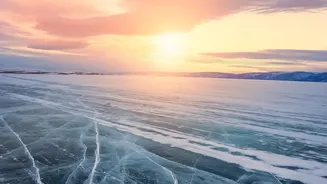
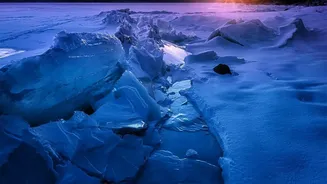
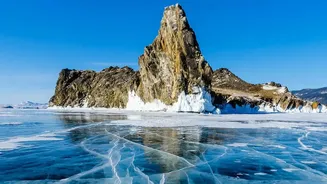
that stretches to the horizon, so clear you can see forty metres down into the dark, still water below. This is the reality of Lake Baikal between February and March. The ice, which can reach over a metre in thickness, is not the cloudy, white ice of a typical frozen pond. Instead, it's a vast expanse of polished, transparent crystal. Sunlight penetrates deep into the ice, creating a spectacular effect. The ice absorbs most colours of the light spectrum but reflects the blues and greens, resulting in a vibrant turquoise glow that seems to emanate from the depths. The surface is a dynamic mosaic of textures: smooth, glass-like plains are interrupted by jagged ridges of ice called 'hummocks' or 'torosy', which are pushed up by the immense pressure of the shifting ice sheet.
The Science of Transparency
The incredible clarity of Baikal's ice is a direct result of the lake's unique water purity. Holding 20% of the world's unfrozen freshwater, Baikal's water is exceptionally clean, containing very few suspended or dissolved minerals. One of the secrets to this purity is a tiny endemic crustacean, the Epischura baikalensis, which acts as a natural filter, constantly consuming algae and other particles. When winter arrives, the lake freezes slowly. At a temperature of -20°C, about four to five centimetres of ice form per day. This gradual process allows impurities and air bubbles to be expelled, resulting in a solid, crystal-clear structure. Unlike regular ice, the dense, bubble-free ice of Baikal scatters less light, allowing it to travel deeper and reveal its famous blue hue.
Braving the Siberian Winter
Witnessing this natural wonder requires enduring some of the planet's harshest winter conditions. Temperatures on the lake frequently drop to between -20°C and -40°C. Strong, unpredictable winds can sweep across the frozen expanse, adding a significant wind chill factor that makes the cold feel even more severe. The ice itself is a living entity, constantly shifting and changing. As temperatures fluctuate, the ice sheet expands and contracts, creating deep cracks that can be several metres wide. This movement is often accompanied by loud booms and cracks that sound like thunder or cannon fire, a phenomenon locals call the 'whisper of Lake Baikal'. Navigating this environment is a serious undertaking; travel on the ice is typically done with experienced local guides and in specialized vehicles like off-road UAZ vans or hovercrafts.
Nature's Frozen Sculptures
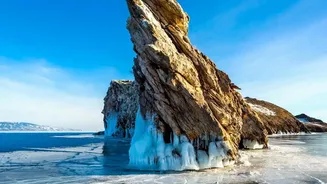
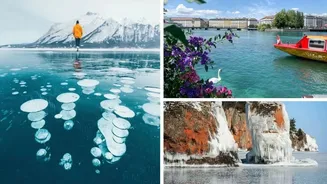
The forces of wind, sun, and pressure combine to create an array of breathtaking ice formations. Near the shores, waves freezing against the rocks create intricate ice caves and grottoes filled with 'sokui', or ice stalactites. In other areas, methane gas bubbling up from the lakebed gets trapped as it freezes, creating fields of suspended white discs that look like a galaxy caught in the ice. Another fascinating phenomenon is 'Baikal Zen', where stones resting on the ice are heated by the sun, melting the ice directly beneath them. When strong winds blow, the stone is left perched on a thin, delicate ice pedestal. Perhaps most mysterious are the giant ice rings, some up to seven kilometers in diameter and visible from space. Scientists believe these are formed by warm, circular eddies swirling beneath the ice cover, which cause the ice to melt in a ring shape.
The Traveler's Experience
The peak season for experiencing Baikal's blue ice is from late February to mid-March, when the ice is at its thickest and most stable, and the weather is often sunnier. During this time, official ice roads are opened, allowing vehicles to traverse parts of the vast lake. For visitors, the experience is otherworldly. Many come to skate on the world's largest ice rink, hike across its transparent surface, or take photographs of the endless, surreal vistas. It's a journey into a landscape of profound silence, broken only by the crackling of the ice and the whistling of the wind. The contrast between the sheer beauty of the glowing ice and the raw, untamed power of the Siberian winter makes a trip to Lake Baikal an unforgettable adventure.