

A Glimpse of Our Sun's Future
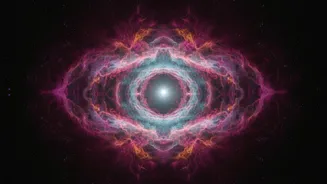
The Helix Nebula is what astronomers call a planetary nebula, a name that's a bit of a misnomer since it has nothing to do with planets. It's the final, beautiful act for a star similar in size to our own sun. When such a star exhausts the hydrogen fuel
in its core, it swells into a red giant. Eventually, it can no longer hold onto its outer layers, which puff away into space over thousands of years. What we see as the Helix Nebula is this expanding cloud of gas, a preview of the fate awaiting our solar system in a few billion years. This process recycles stellar material back into the cosmos, providing the raw ingredients for the next generation of stars and planets.
Lighting Up the Darkness
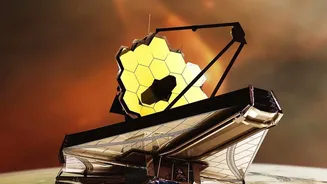
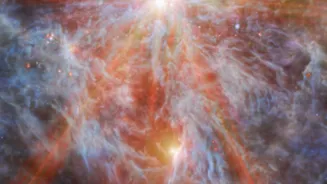
Shedding gas is only the first step. For a nebula to get its glow, it needs a power source. At the heart of the Helix Nebula lies the star’s collapsed core: an incredibly hot, dense white dwarf. This stellar remnant, no longer producing energy through fusion, blasts out intense ultraviolet radiation. This high-energy light slams into the previously ejected gas clouds, causing them to fluoresce, or glow brightly, in a stunning display of colors. Recent images from the James Webb Space Telescope show this in incredible detail, with different colors representing gas at different temperatures—from the hottest gas closest to the star to cooler molecular hydrogen farther out.
The Cosmic Collision
So, what creates the intricate filaments and textures that make the nebula so complex? The answer lies in a multi-stage cosmic collision. The star didn’t eject its gas all at once. There were earlier, slower waves of cooler gas and dust, followed by a later, faster “wind” of hotter gas from the exposed stellar core. As the new, faster wind plows into the older, slower shells, it creates shocks and instabilities, sculpting the material into the elaborate structure we see. From our vantage point on Earth, we appear to be looking down a long tunnel or cylinder of this glowing gas, which is why it takes on its signature ring-like shape.
A Forest of Cometary Knots
Perhaps the most fascinating features are the thousands of tiny, tadpole-shaped objects lining the inner ring, known as “cometary knots.” These aren't actual comets, but they have glowing heads and long tails stretching away from the central star. Each knot's head is massive, often twice the size of our entire solar system. While their exact origin is still a topic of research, the leading theory is that they are dense clumps of cooler, dusty gas that were present in the initial cloud. As the intense radiation from the white dwarf heats the surrounding nebula, these dense knots are able to shield the material behind them, creating long, shadowy tails. This process, called photoevaporation, shapes them into their distinct, comet-like forms, adding another layer of deep complexity to this celestial masterpiece.