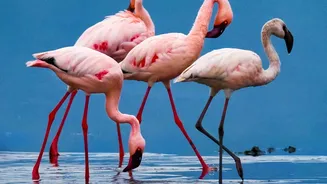


The image is iconic: a flock of bright pink flamingos standing in shimmering shallow water, their long necks curved gracefully downwards. But their feeding posture is bizarrely inverted. This isn't just a quirk; it's a brilliant evolutionary trick.
A World Turned Upside Down
When
a flamingo dunks its head to eat, it does so completely upside down, with its bill pointing back towards its feet. To us, it looks awkward and uncomfortable, but for the flamingo, it is the most efficient way to eat. This behaviour is directly linked to their highly specialized diet and the unique anatomy of their beak. They spend much of their day in this posture, sweeping their heads from side to side through the water in lagoons, salt flats, and shallow lakes. This motion isn't random; it's a calculated method to stir up their next meal from the muddy bottom.
The Ultimate Filter Feeders
Flamingos are what biologists call 'filter feeders'. Their diet consists of tiny organisms like algae, diatoms, larvae, small insects, molluscs, and crustaceans such as brine shrimp. Many of these food sources are microscopic and suspended in water or mixed in with mud and silt. To consume them, the flamingo needs a way to separate the minuscule morsels from the water. This is where their strange, bent beak and upside-down technique come into play. It transforms their bill into a highly effective sieve, similar in function to the baleen plates of a giant whale.
A Perfectly Reversed Beak
Unlike most birds that have a smaller lower beak (mandible) and a larger upper beak, a flamingo's bill is essentially reversed in function. The lower mandible is a large, trough-like structure, while the much smaller upper mandible acts as a lid. When the flamingo inverts its head to feed, this anatomy suddenly makes perfect sense. The large lower bill is in the top position, creating a deep scoop to gather water, while the upper bill sits underneath. Uniquely among birds, the flamingo's upper jaw is not fused to its skull, allowing it to move while eating.
The Piston and the Sieve
Once its beak is full of water and mud, the flamingo puts its powerful tongue to work. The large, fleshy tongue fits snugly into the groove of the lower mandible and acts like a piston. By pumping its tongue back and forth rapidly—up to four or five times per second in some species—the bird forces water out of the sides of its beak. Lining the edges of the beak are comb-like plates called lamellae. These intricate, bristle-like structures act as the filter, trapping the tiny shrimp and algae inside while the water and mud are expelled. The bird then swallows the collected food.
You Are What You Eat
This specialized diet is also responsible for the flamingo's most famous feature: its vibrant pink colour. Flamingos are not born pink; they hatch with dull grey or white feathers. Their diet of algae and crustaceans is rich in natural pigments called carotenoids—the same pigments that make carrots orange and tomatoes red. When a flamingo eats these organisms, its digestive system breaks down the carotenoids, which are then deposited in its growing feathers, turning them shades of pink, orange, or red. A brightly coloured flamingo is a sign of a well-fed and healthy bird, making it a more desirable mate.