





The Ultimate All-Rounder Test
To understand the magnitude of Tejaswin Shankar’s achievement, one must first understand the decathlon. It is not just an event; it is an ordeal. Spread over two exhausting days, athletes compete in ten different track and field disciplines. Day one is a test
of explosive power and speed: the 100-metre dash, long jump, shot put, high jump, and the lung-searing 400-metre run. Day two challenges technique and endurance with the 110-metre hurdles, discus throw, the technically demanding pole vault, javelin throw, and finally, the punishing 1500-metre run. The winner is not the best specialist, but the most complete athlete—the one who can sprint, jump, throw, and endure with unwavering consistency. It's a discipline that has the highest injury rate in athletics, with nearly a third of competitors often failing to finish. Winning any medal is a triumph of will.
From High Jump Star to Decathlon Hero
For years, Indian sports fans have known Tejaswin Shankar as a high jump specialist. Standing at an imposing 6-foot-4, he made history by winning India’s first-ever Commonwealth Games high jump medal—a bronze—at Birmingham in 2022. But for an athlete of his ambition, mastering one event was not enough. He transitioned his focus to the decathlon, a move that requires a complete rewiring of an athlete's training, mindset, and physical capabilities. His silver medal at the Asian Games in 2023 was a clear signal of his potential. The journey from a specialist to a master of ten events is a lonely, brutal road. It involves learning new techniques, building different muscle groups, and developing a unique mental fortitude to handle the constant shift in focus from one discipline to the next.
An Epic Performance in Glasgow
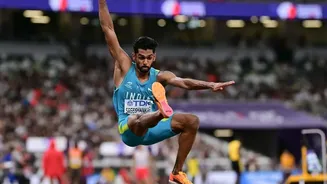
Shankar’s performance at the 2026 Glasgow Commonwealth Games was a drama in itself. He arrived nursing a chronic knee injury that forced him to withdraw from the individual high jump event in tears, casting doubt on his ability to even compete in the decathlon. Yet, he persevered. Over two days, he battled through the pain, collecting 7,976 points to secure his historic bronze. His performance was a showcase of his grit, particularly in his signature high jump event where he soared to 2.15 metres, out-jumping the entire field. After slipping in the standings, a powerful performance in the javelin throw catapulted him back into medal contention before he sealed the deal in the final 1500m race. He shared the podium with legends of the sport, including three-time champion Lindon Victor and Olympic champion Damian Warner, cementing his place among the world's elite.
Why This Bronze Carries the Weight of Gold
In a nation that rightly celebrates its cricket centurions and single-event medallists, an achievement like Shankar’s can be hard to contextualize. But this bronze is a landmark moment. Before him, no Indian had ever won a Commonwealth Games medal in the decathlon. This is not just about winning; it is about breaking new ground in a discipline where India has had very little historical presence. While a specialist hones one skill to perfection, a decathlete must pursue excellence in ten different, often conflicting, athletic abilities. The training is a complex balancing act, pushing the body to its absolute limit while managing the constant risk of injury. Shankar's medal isn't just a personal victory; it is a signal that Indian athletics is expanding its horizons beyond traditional strongholds.
A New Benchmark for Indian Athletics
Tejaswin Shankar’s heroics in Glasgow do more than just add another medal to India's tally. They set a new standard for versatility and resilience. He has now become the first Indian to win Commonwealth Games medals in two different disciplines—high jump and decathlon. This achievement sends a powerful message to a new generation of Indian athletes: that it is possible to break the mould and succeed in the most demanding arenas of sport. His journey from a high jump specialist to a decathlon medallist proves that with courage and immense hard work, new frontiers can be conquered. This bronze medal is not just a reward for two days of gruelling competition; it is an inspiration, a blueprint for the future of Indian track and field.