



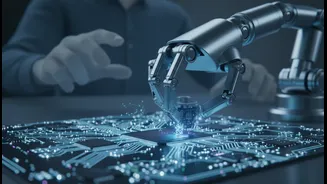



For Developers: From Writing Code to Orchestrating Agents
The role of the developer is undergoing a fundamental shift. While AI-assisted coding tools like GitHub Copilot have become standard, the next evolution is toward so-called agentic workflows. Instead of just getting line-by-line suggestions, developers
will increasingly define a task and delegate the entire implementation cycle to an autonomous AI agent. This agent can write code, run tests, debug failures, and open a pull request for human review. This moves the developer's primary function from writing to reviewing and from manual execution to system orchestration. The skills required are also changing. Mastery of multimodal AI models, which understand text, images, and video, will become crucial. Developers will need to become adept at designing systems that can process diverse data inputs and at orchestrating networks of specialized AI agents that collaborate on complex goals.
For Video Creators: AI as a Creative Partner, Not a Replacement
Generative video has moved from a quirky novelty to a serious production tool. Platforms like Google's Veo 3 and Runway's Gen-4 are offering cinematic quality and advanced controls, allowing creators to generate clips from text or image prompts. By 2026, the quality of AI-generated video is expected to be nearly indistinguishable from real footage for many use cases, with tools offering features like AI-generated sound effects and voice. For creators, this means the technical barriers to high-quality video production are falling dramatically. The new essential skill is becoming a kind of 'AI whisperer'—someone who can translate a creative vision into prompts and parameters that guide the AI effectively. The workflow is shifting from manual post-production to iterative refinement and creative direction, using AI as a tireless brainstorming partner and production assistant. Creative control remains paramount, but it's expressed through direction and editing rather than manual asset creation.
For Client-Facing Teams: The New Translators
For project managers and client-facing teams, the AI revolution presents a dual challenge: managing expectations and ensuring responsible implementation. AI projects are different from traditional software projects; they are often experimental, iterative, and require constant monitoring and refinement as models evolve. A key responsibility will be to clearly define project objectives and set realistic expectations with stakeholders, communicating AI's capabilities as well as its limitations. These teams will need a stronger grasp of technical concepts like machine learning fundamentals, data governance, and the AI lifecycle. They are the bridge between business goals and technical execution, responsible for ensuring that AI projects deliver real value while navigating ethical considerations like data privacy and algorithmic bias. Success will depend on fostering clear communication and collaboration between technical and non-technical stakeholders.
The Future is Hybrid: Converging Workflows
The most significant change isn't happening within these individual roles, but at the intersection between them. AI is forcing the creation of hybrid, cross-functional teams where developers, creators, and project leads share a common vocabulary. A developer might use a multimodal model to generate code for a visual application, a video creator might need to understand API integrations to pull data into their content, and a project manager must comprehend the technical dependencies of both. This convergence means that siloed knowledge is becoming a liability. The teams that will thrive are those that operate in tightly integrated loops, where a developer can understand a creative brief and a creator can appreciate the logic of an agentic workflow. The future of AI development is not just about smarter tools, but about creating smarter, more collaborative, and deeply interconnected teams.