




The Flash and the Cannonball
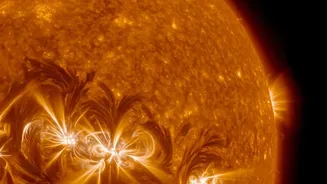
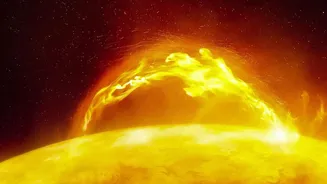
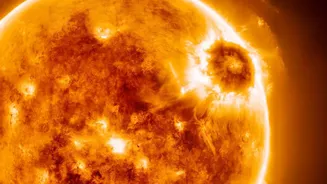
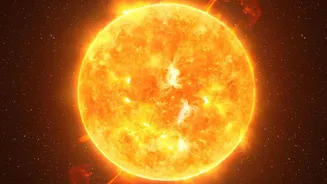
When we talk about solar storms, it's easy to confuse two distinct events: solar flares and coronal mass ejections (CMEs). Think of a solar flare as the bright muzzle flash of a cannon. It’s an intense burst of radiation that we see on Earth about eight
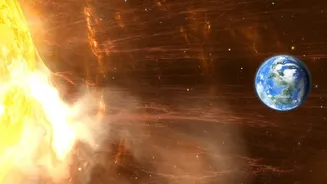
minutes after it happens. While flares can disrupt radio and GPS signals, they aren't the primary threat to the power grid. The real danger is the CME, which is like the cannonball itself. A CME is a colossal eruption of plasma and magnetic fields from the sun's outer atmosphere, the corona. This billion-ton cloud of charged particles travels much slower than light, offering a window of opportunity to prepare for its arrival. It's the impact of this CME with Earth's magnetic field that can wreak havoc on our infrastructure.
Creating an Eclipse on Demand
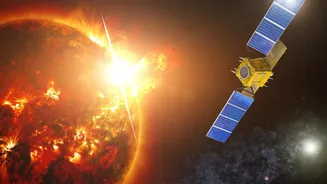
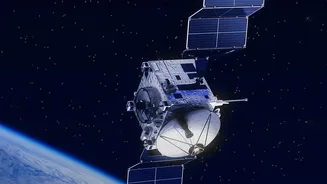
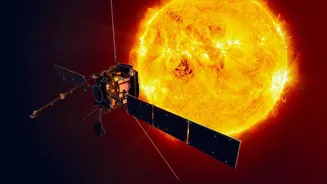
To spot a CME leaving the sun, scientists need a special tool called a coronagraph. The sun's surface is so blindingly bright that it completely obscures its much fainter outer atmosphere, the corona. A coronagraph works by creating an artificial eclipse. It uses a small, precisely placed disc to block the direct light from the sun's main body. This allows the telescope to see the delicate, streaming structures of the corona and, crucially, to spot a massive cloud of plasma when it bursts into space. For decades, the LASCO coronagraph on the SOHO satellite was our primary eye on the sun. Now, a new generation of instruments, like the Compact Coronagraph (CCOR) aboard satellites such as GOES-19 and SOLAR-1, are providing even faster and more reliable imagery to ensure we never lose sight of a potential threat.
From Detection to Alert
Once a coronagraph captures images of an Earth-directed CME, a race against time begins. The data is beamed from the satellite—often positioned 1.5 million kilometers away—back to Earth. It arrives at centers like the National Oceanic and Atmospheric Administration's (NOAA) Space Weather Prediction Center (SWPC). There, expert analysts and sophisticated computer models, like the WSA-Enlil model, get to work. They analyze the sequence of images to determine the CME's size, speed, and trajectory. By modeling its path through the solar system, they can forecast if and when it will impact Earth. This analysis is what transforms a simple observation into a concrete warning that can be issued to industries that rely on this information.
A One to Four-Day Warning
The key to the entire early-warning system lies in physics. The light from the CME eruption reaches our satellites in about eight minutes. The ejected material, however, travels much more slowly. A typical CME takes between one and four days to cross the 150 million kilometers to Earth. This time lag is the golden window for preparation. Based on the SWPC's forecast, alerts are sent out to critical infrastructure operators, including power grid controllers. These aren't vague advisories; they come in the form of official watches and warnings that indicate the expected timing and severity of the coming geomagnetic storm on a scale from G1 (minor) to G5 (extreme).
How Grid Operators Brace for Impact
When a grid operator receives a geomagnetic storm warning, they don't just flip a giant off switch. Doing so would cause its own chaos. Instead, they execute a series of carefully planned procedures to make the grid more resilient. These actions may include postponing non-critical maintenance, bringing offline power lines back into service to better distribute the load, and increasing spinning reserves by bringing standby generators online to help stabilize voltage. The primary threat is from geomagnetically induced currents (GICs), which are rogue DC currents that the storm induces in long transmission lines. These currents can saturate high-voltage transformers, causing them to overheat and potentially suffer permanent damage. By taking these proactive steps, operators can manage the stress on the system and mitigate the risk of a widespread, long-lasting blackout.