


First, Let’s Redefine Time
Before we dive into the weirdness of Venus, let's quickly reset our understanding of a 'day' and a 'year'. On Earth, this is simple. A year is the time it takes our planet to complete one full orbit around the Sun—roughly 365 days. A day is the time it takes for the Earth to spin
once on its own axis—about 24 hours. We experience this as a cycle of daylight and darkness. This familiar rhythm governs our lives, but the universe doesn't play by the same rules everywhere.
Venus's Quick Trip Around the Sun
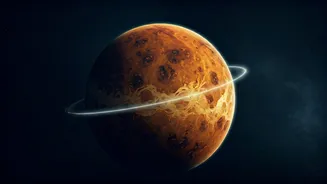
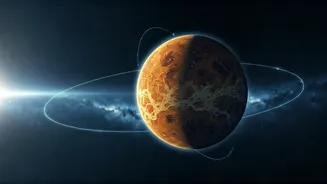
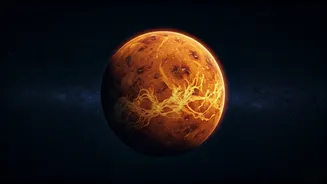
Let’s start with the Venusian year. Venus is the second planet from the Sun, closer than Earth. Because its orbital path is shorter and it moves faster through space, it completes a full circle around the Sun in just about 225 Earth days. So, if you were living on Venus, your 'year' would be significantly shorter than an Earth year. You’d be celebrating your birthday roughly every seven and a half months. So far, so good. It’s when we look at the Venusian day that things get truly bizarre.
A Day That Lasts Forever
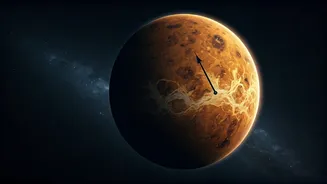
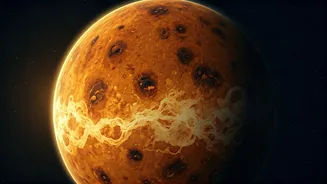
Here is the mind-bending part. A 'day' is defined by a planet's rotation. Venus rotates on its axis incredibly slowly. In fact, it takes approximately 243 Earth days for Venus to complete just one full spin. Now, compare that to its year. A single rotation (243 days) takes longer than a full orbit around the sun (225 days). This means that on Venus, a day is literally longer than a year. It's the only planet in our solar system with this strange characteristic.
The Planet That Spins Backwards
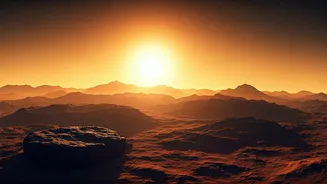
To make matters even stranger, Venus spins in the opposite direction to Earth and most other planets in our solar system. This is called retrograde rotation. If you could stand on the surface of Venus (which you can't, due to the crushing pressure and acid clouds), you would see the Sun rise in the west and set in the east. Scientists aren’t entirely sure why Venus is such an oddball. The leading theory suggests a colossal asteroid impact in its distant past might have knocked it off-kilter, slowing its rotation and eventually reversing it. Another theory points to the planet's thick, heavy atmosphere creating a drag that slowed its spin over billions of years.
But Wait, What About a Sunrise?
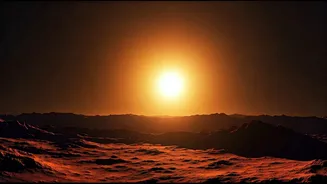
Here’s a final twist. While a rotational day (a sidereal day) is 243 Earth days, a 'solar day' on Venus—the time from one sunrise to the next—is different. Because the planet is rotating backwards while it orbits the Sun, the two motions partially cancel each other out from the perspective of an observer on the surface. The result is that a solar day on Venus is 'only' about 117 Earth days long. So, you’d experience one sunrise and one sunset roughly every four months. It’s still an incredibly long time to wait for morning, but it shows just how complex planetary mechanics can be.