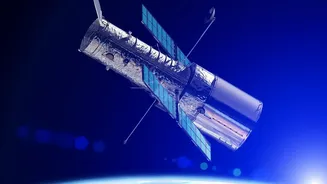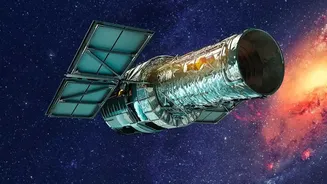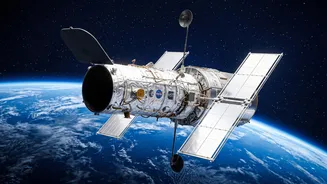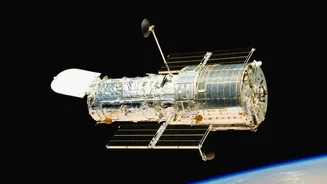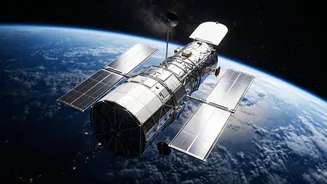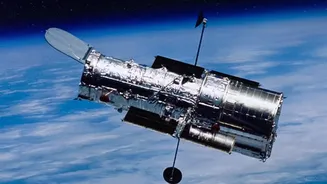






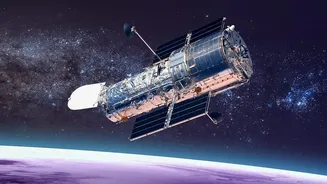

For over 35 years, the Hubble Space Telescope has been humanity’s eye on the cosmos. Now, its legendary watch may be nearing an end. The iconic observatory is slowly falling, and NASA is turning to the commercial space industry for a rescue plan.
A Legacy in a Slow Descent
Since
its launch in 1990, the Hubble Space Telescope has revolutionized our understanding of the universe, contributing to more than 23,000 scientific papers. But after decades of groundbreaking service, the telescope is facing a slow but inevitable problem: orbital decay. Orbiting hundreds of kilometers above the planet, Hubble is still affected by faint atmospheric drag that gradually lowers its altitude. The last time astronauts raised its orbit was during a Space Shuttle servicing mission in 2009. Without its own propulsion system, the telescope's orbit has been shrinking ever since. Current projections show Hubble could make an uncontrolled reentry into Earth's atmosphere between 2033 and 2034, posing a risk and ending its historic mission.
A Call for Commercial Creativity
Instead of designing a new government-led mission, NASA's Goddard Space Flight Center issued a Request for Information (RFI) on October 29, 2026. An RFI is not a contract; it's a form of market research to gauge what's possible. NASA is asking private companies to submit their ideas, technical capabilities, and estimated costs for saving Hubble by a deadline of November 30. This marks a significant shift, framing the extension of a priceless scientific asset as a potential commercial service. The move signals that the agency is serious about exploring cost-effective, innovative solutions from a rapidly evolving private space industry. The agency previously studied a private reboost mission with SpaceX but ultimately declined at the time.
More Than Just a Boost
The RFI lays out three main possibilities for industry partners. The first, and most obvious, is to 'reboost' Hubble to a higher, more stable orbit of at least 600 kilometers, which could extend its life by decades. The second option is a more ambitious servicing mission to potentially upgrade its systems and improve performance, similar to the crewed shuttle missions of the past, but likely using robotics. The third option is a managed 'deorbit', where a spacecraft would safely guide Hubble to a controlled reentry over an unpopulated area of the ocean. Any mission would need to happen by 2032 and would require the commercial partner to provide the launch vehicle, the servicing spacecraft, and mission operations.
The Future of Space Stewardship
This call for ideas is more than just an attempt to save a single telescope; it is a test case for the future of in-space servicing. Companies like Northrop Grumman have already demonstrated commercial life-extension services for satellites in higher orbits. NASA's RFI is a clear signal that a market may be opening for similar services in low Earth orbit for high-value government assets. A successful commercial mission to Hubble would not only preserve its unique scientific capabilities—particularly in ultraviolet light, which newer telescopes like JWST don't cover—but also create a valuable precedent. It would prove that public–private partnerships can work to sustain our most important infrastructure in space, turning what was once a disposable mission into a serviceable, long–term asset.