






Our Planet’s Constant Tilt
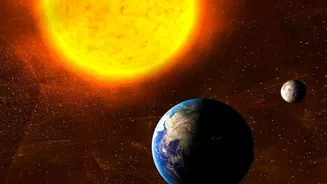
Imagine Earth spinning like a top as it orbits the sun. Now, picture that top being permanently tilted to one side. That’s our planet. Earth’s axis—an imaginary line running through the North and South Poles—is not straight up and down relative to its path
around the sun. Instead, it’s tilted by about 23.5 degrees. This tilt is the single most important factor in creating seasons. Contrary to popular belief, seasons are not caused by Earth being closer to or farther from the sun. In fact, the Northern Hemisphere is actually closest to the sun during its winter. The magic is all in the angle of this lean, which remains pointed in the same direction towards the stars throughout our year-long journey.
What is an Equinox, Really?
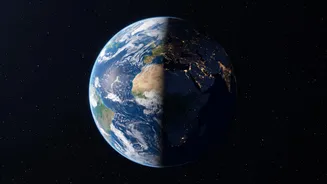
Twice a year, in March and September, Earth reaches a special point in its orbit. On these days, the planet's tilt is neither pointing towards the sun nor away from it. Instead, it’s positioned perfectly sideways relative to the sun. At this precise moment, the sun's rays shine directly over the Earth's equator. This event is called an equinox, derived from Latin for "equal night." While day and night are not perfectly equal due to factors like atmospheric refraction, they are very close to 12 hours each all across the globe. The September equinox is the moment the sun crosses the celestial equator moving from north to south.
Connecting the Tilt to the Seasons
Because of the 23.5-degree tilt, for half of the year, the Northern Hemisphere leans towards the sun, experiencing summer with more direct sunlight and longer days. For the other half, it leans away, getting less direct sunlight, which brings on winter. The equinoxes are the balancing points between these two extremes. The September equinox marks the astronomical start of autumn in the Northern Hemisphere. After this date, the Northern Hemisphere will begin to tilt further away from the sun, leading to shorter days and longer nights until we reach the winter solstice in December. This gradual change is what drives the shift in our climate and environment.
A Tale of Two Hemispheres
While we in India and the rest of the Northern Hemisphere welcome autumn, the Southern Hemisphere is having the exact opposite experience. For countries in South America, southern Africa, and Australia, the September equinox marks the vernal, or spring, equinox. As our days grow shorter, theirs begin to lengthen. They are starting their tilt towards the sun, heralding warmer weather and the onset of summer. This global symmetry is a direct consequence of our planet's tilt, creating a balanced but opposite seasonal rhythm on either side of the equator. On the day of the equinox itself, both the North and South Poles are simultaneously in sunlight, a unique occurrence that only happens twice a year.
What the Equinox Means for India
In India, the September equinox is more than just an astronomical event; it’s a marker of profound seasonal change. It traditionally signals the retreat of the summer monsoon and the beginning of a cooler, drier period for much of the country. The days, which had been long and humid, start to shorten noticeably, and the nights grow longer. This shift is a fundamental part of our natural and agricultural calendar. Some ancient Indian structures were even built with this day in mind. For instance, at the Sree Padmanabhaswamy Temple in Kerala, the setting sun on the equinox aligns perfectly with the windows of its main tower, a testament to the advanced architectural and astronomical knowledge of our ancestors.