







The Spark of Life
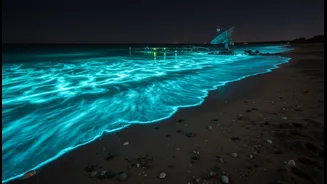
The captivating glow seen on coastlines from Maharashtra to Goa is a phenomenon called bioluminescence, which is light produced by a living organism. The primary culprit behind these 'sea sparkles' is a type of single-celled plankton known as a dinoflagellate,
most commonly Noctiluca scintillans. When these microscopic organisms are disturbed by waves, a boat, or even a hand trailing in the water, they emit a bright blue flash as a defense mechanism. This light is the result of a chemical reaction involving a light-emitting molecule called luciferin and an enzyme, luciferase. While a single flash is tiny, when billions of these organisms bloom together in a dense patch, their collective glow can illuminate entire stretches of coastline, creating an unforgettable spectacle.
The View From Above
One of the most powerful ways scientists track the intensity and spread of these blooms is from space. Earth-observing satellites from NASA and the European Space Agency are equipped with instruments that can detect the tell-tale signs of algal blooms. These satellites don't see the bioluminescence directly; instead, they measure the concentration of chlorophyll-a, the pigment that gives phytoplankton its green colour. By analysing the colour of the ocean surface, scientists can create detailed maps showing the location and density of these blooms. Newer technologies, like microwave remote sensing and AI-driven models, are improving these capabilities, allowing for detection even on cloudy days and helping to distinguish harmful algal blooms from harmless ones. This bird's-eye view is crucial for understanding the large-scale dynamics of blooms that can stretch for hundreds of kilometres.
Getting Up Close and Personal
While satellites provide the big picture, understanding the intensity of the glow requires getting much closer. For this, marine biologists deploy a range of in-water instruments. A key tool is the bathyphotometer. These devices are deployed at various depths and work by pulling seawater into a dark chamber. The turbulence stimulates any bioluminescent organisms in the sample to flash, and a sensitive light detector measures the exact amount of light produced. This gives researchers a direct measurement of the 'bioluminescence potential' of the water. By combining this with water samples analysed under a microscope, scientists can determine not only how bright the glow is, but also which specific species are causing it and in what concentration.
Why We Need to Watch the Glow
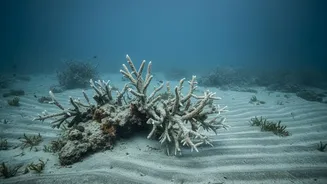
Tracking these glowing shores is more than just appreciating a natural wonder. The frequency and intensity of Noctiluca blooms are considered important indicators of ocean health. While not always directly toxic, these massive blooms can have devastating consequences. As the bloom consumes oxygen in the water, it can create hypoxic 'dead zones' where fish and other marine life cannot survive. This has led to fish kills and coral mortality in areas like the Gulf of Mannar. In the Arabian Sea, scientists have noted that these blooms are becoming more common and are replacing diatoms, a foundational part of the marine food web. Researchers believe this shift is linked to changing water temperatures and low-oxygen zones, potentially driven by climate change.
Putting the Data to Work in India
Along India's vast coastline, bioluminescence reports have been on the rise. Scientists at institutions like the Indian National Centre for Ocean Information Services (INCOIS) are using a combination of satellite data and on-the-ground studies to monitor these events. The goal is to develop early warning systems. By predicting when and where these blooms will occur, authorities can warn local fishing communities and aquaculture farms, potentially helping them harvest fish before a bloom causes widespread damage. This research is vital for protecting both the delicate coastal ecosystems and the livelihoods of the millions of people who depend on them.