



The Classic 'Goldilocks' Zone
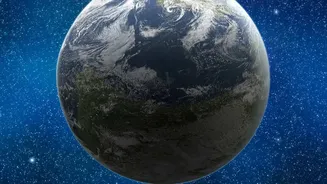
For as long as we have searched the stars, our main guide has been the concept of the 'habitable zone'. Often called the 'Goldilocks zone', this is the orbital region around a star where conditions are not too hot and not too cold, but just right for
liquid water to exist on a planet's surface. Since liquid water is considered a fundamental ingredient for life as we know it, finding rocky planets in this zone has been the primary goal for missions like the Kepler space telescope. This 'Earth-centric' approach makes sense; if we're looking for life, it's logical to start by looking for conditions that mirror our own. But some scientists now argue this might be too narrow a view, potentially causing us to overlook worlds that are far more promising.
What Makes a Planet 'Super'?
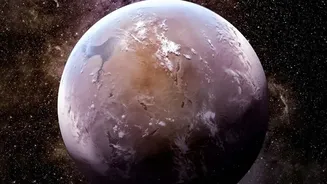
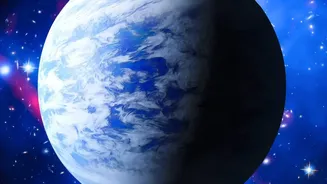
The term 'superhabitable' was proposed to describe planets that could support more biodiversity and a greater abundance of life than Earth. It's a shift in perspective from finding a mirror image of our world to identifying worlds with conditions that are theoretically more optimal for life to emerge and thrive. According to Dirk Schulze-Makuch, a geobiologist who has led research in this area, our focus on finding a second Earth could mean we miss planets that are even better suited for life. A superhabitable world isn't just a place where life could exist; it's a place where the conditions might make life more likely and more robust.
The Recipe for a Better World
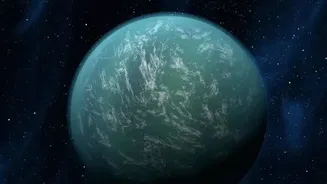
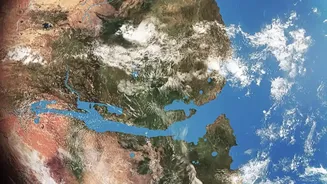
Scientists have developed a checklist of traits that could make a planet superhabitable. Ideally, such a planet would orbit a K-dwarf star. These stars are cooler and less massive than our Sun (a G-type star) but have incredibly long lifespans of 20 to 70 billion years, compared to our Sun's 10 billion. This provides a much longer, more stable period for complex life to evolve. A superhabitable planet would likely be slightly older than Earth (around 5 to 8 billion years old), about 1.5 times more massive, and a little larger. This extra mass helps it retain a thicker atmosphere, while the larger size could mean more surface area. Finally, a world slightly warmer and wetter than Earth, with moisture distributed across many small landmasses instead of giant continents, could foster greater biodiversity, similar to our own tropical rainforests.
The Hunt for Super-Earths
This isn't just a thought experiment. In 2020, Schulze-Makuch and his team scoured the list of over 4,000 known exoplanets and identified 24 top contenders for superhabitability. It is important to note that these are just candidates, and many are yet to be confirmed as definite planets. All of them are more than 100 light-years away, making direct observation impossible with current technology. However, identifying these targets helps astronomers focus the efforts of powerful new tools like the James Webb Space Telescope. Among the candidates, none meet all the criteria perfectly, but some, like KOI 5715.01, show several promising characteristics that make them exciting subjects for future study.
Habitable vs. Inhabited: The Key Difference
This leads to the most critical distinction of all. 'Habitable' and 'superhabitable' are labels that describe potential. They mean a planet has the right physical conditions—like temperature, size, and the potential for water—for life to exist. 'Inhabited', on the other hand, means we have found definitive proof of life. To date, no exoplanet has been confirmed as inhabited. Finding that proof would require detecting 'biosignatures'—gases or chemical compounds in a planet's atmosphere that could only be produced by living organisms. This is an incredibly difficult task that will push our technology to its limits. A planet can be the most perfect, superhabitable world imaginable and still be completely lifeless.