



The Golden Rule: Gradual Progression
The single most important principle in any strength training is progressive overload. It simply means that to get stronger, you must continually ask your body to do slightly more than it's used to. Without this, your progress will eventually stall or 'plateau'.
In a gym, this often means adding more weight to a barbell. In a playground, using only your bodyweight, progression looks a little different. You can make an exercise more challenging by increasing repetitions, adding another set, reducing rest time, or, most effectively, by moving to a more difficult variation of the exercise. This guide focuses on that last method: mastering a move and then taking the next step up the ladder.
Foundational Move: The Push
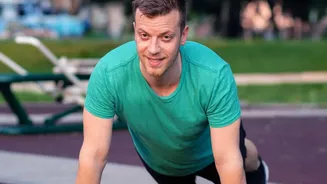
The push-up is a fundamental movement for building strength in your chest, shoulders, and triceps. The playground offers a perfect way to scale this exercise. Instead of starting on the floor, find a wall, fence, or the back of a bench. The more upright your body is, the easier the exercise will be. Start with incline push-ups, placing your hands on a high surface. As you get stronger, find lower surfaces, like the seat of a bench, to increase the difficulty. Once you can comfortably perform several sets of 10-15 reps, you're ready to try them on the ground. From there, you can progress to decline push-ups by placing your feet on a bench, which adds even more resistance.
Foundational Move: The Pull
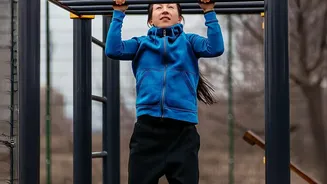
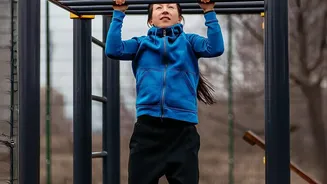
Pulling exercises are crucial for a strong back and biceps, and they often feel like the most challenging to start. Forget about doing a full pull-up on day one. Your first step is the inverted row (also called an Australian pull-up). Find a low bar, around hip or chest height. Lie underneath it, grab the bar, and pull your chest towards it while keeping your body in a straight line. The more horizontal your body is, the harder it will be. Once you master these, you can move to the pull-up bar. Start with 'negatives': jump or step up to the top position (chin over the bar) and lower yourself down as slowly as possible, aiming for 3-5 seconds. These build the exact strength needed for your first full pull-up.
Foundational Move: The Squat
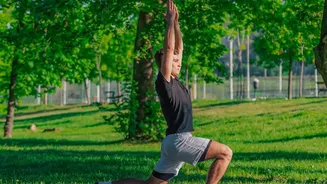
No workout is complete without training your legs, and the bodyweight squat is the king of lower-body exercises. Stand with your feet shoulder-width apart and lower your hips as if sitting in a chair, keeping your back straight and chest up. Aim to get your thighs parallel to the ground, or lower if your mobility allows. Once you can easily do 15-20 reps with perfect form, it's time to progress. You can make it explosive by turning them into jump squats, focusing on landing softly. For a real strength challenge, start working on single-leg variations. Begin with assisted lunges or split squats, holding onto a bench for balance. Eventually, you can progress towards an assisted pistol squat, building incredible single-leg strength and stability.
Core and Consistency
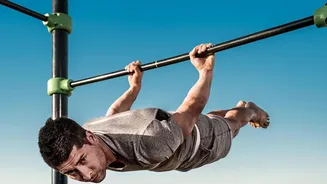
A strong core is the foundation of all movement, and almost every playground exercise engages it. To target it directly, use the pull-up bar for hanging knee raises. Simply hang from the bar and bring your knees to your chest without swinging. For a harder variation, keep your legs straight and raise them towards the bar. A beginner routine should include a push, a pull, a leg exercise, and a core exercise. Aim to work out two or three times a week, performing 3 sets of 8-12 repetitions for each exercise. Remember to warm up before you start and listen to your body. Progress comes from consistency, not intensity. Start where you are, and focus on getting just a little bit better each week.