



Earth: The One-Planet Case Study
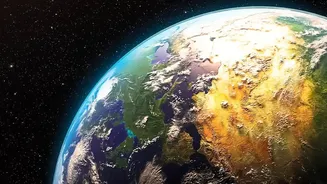
Earth is our only confirmed example of a planet teeming with life. This unique position makes its 4.5-billion-year history an invaluable template for astrobiologists. By studying the different chapters of our world's evolution—from a molten ball to a frozen
snowball and a lush, green oasis—scientists can identify what a habitable planet might look like at various stages of its development. These different periods offer glimpses into largely alien worlds that may be perfect analogs for distant exoplanets. NASA's Habitable Worlds program is specifically designed to use knowledge of Earth's history as a guide to pinpoint the conditions that create and maintain environments capable of supporting life. It's a scientific strategy based on a simple premise: to find life elsewhere, you must first understand every facet of the one living world you can actually touch.
Reading the Ancient Rock Record
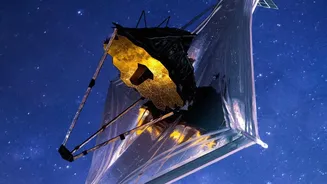
Scientists in the field of paleoclimatology study natural archives like rocks, sediments, and ice cores to reconstruct past climates. These records hold chemical clues, or "biosignatures," that signal the presence of past biological activity. For example, the discovery of specific carbon isotopes in ancient rocks can point to the existence of microbial life billions of years ago. By understanding what these early, subtle signs of life look like in Earth's geological record, researchers can better design telescopes and methods to look for similar fingerprints in the atmospheres of distant planets. The goal is to spot telltale gases like oxygen, methane, or ozone that might indicate a thriving biosphere. But Earth's history teaches us that this isn't always straightforward. For much of its past, Earth had life but very little detectable oxygen in its atmosphere, a potential "false negative" that could mislead astronomers. Studying these periods helps scientists refine what to look for.
Lessons from a Harsher, Stranger Earth
Our planet's past was filled with extreme climatic shifts that test our very definition of "habitable." Take the "Snowball Earth" periods, when the planet was covered almost entirely in ice for millions of years. Life didn't just vanish; it survived. Recent studies suggest that meltwater ponds or areas of open ocean, perhaps near volcanic vents or even in mid-latitudes, acted as refuges for early organisms. Similarly, the "Great Oxidation Event" around 2.4 billion years ago dramatically changed the atmosphere from one with almost no oxygen to one where it was abundant, fundamentally reshaping life on the planet. By modeling these extreme events, scientists can expand their search criteria for life on other worlds. A planet that looks like a frozen wasteland or has a hazy, oxygen-poor atmosphere might not be a dead end—it might just be going through its own version of an ancient, challenging Earth.
Life at the Absolute Limits
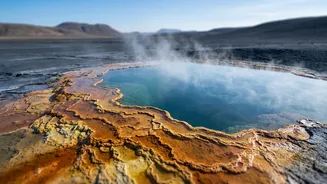
Perhaps the most exciting clues come from Earth's toughest inhabitants: extremophiles. These are organisms, mostly microbes, that thrive in conditions humans would find unsurvivable. They live in boiling hot springs, highly acidic waters, salty crystals, and even the cores of nuclear reactors. The existence of these lifeforms dramatically broadens the potential scope for life elsewhere. If life can flourish in the harshest niches on Earth, it might also find a way on planets with freezing temperatures, toxic atmospheres, or high radiation. Astrobiologists no longer focus solely on finding perfect Earth-like twins. Thanks to extremophiles, they now consider worlds with underground oceans, frozen surfaces, or thick, hazy atmospheres as potential candidates. These resilient organisms prove that life doesn't necessarily require perfect conditions, just the incredible ability to adapt.