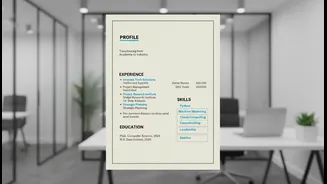









Mindset Shift: From CV to Résumé
The first step is understanding the fundamental difference between an academic Curriculum Vitae (CV) and an industry résumé. An academic CV is a comprehensive, multi-page record of your entire scholarly life: publications, conferences, teaching, and service.
Its goal is to prove your expertise to other experts. An industry résumé, by contrast, is a one-to-two-page marketing document. Its sole purpose is to show a recruiter—who may spend only seconds scanning it—that you have the specific skills to solve their company's problems. It’s not about listing everything you’ve ever done; it’s about curating what is most relevant to a specific job.
Translate Duties into Impactful Achievements
Academic CVs often list responsibilities. Industry résumés must highlight achievements. Instead of stating what you were responsible for, explain what you accomplished and what the result was. Use action verbs and quantify your impact whenever possible. For example, instead of “Conducted research on photonic materials,” try reframing it with a results-oriented formula: “Led a 6-month research project on photonic materials that identified a 15% increase in efficiency, contributing to a successful grant application.” This shifts the focus from your duties to the value you created.
Showcase Transferable Skills, Not Just Topics
Hiring managers outside of academia may not understand the niche details of your dissertation topic, but they desperately need the skills you used to complete it. Focus on translating your academic experience into the language of business. Your transferable skills include project management, data analysis, critical thinking, problem-solving, and communication. Instead of listing your grant by its academic title, frame it as “secured competitive funding” or “managed project budgets.” Teaching experience demonstrates leadership, public speaking, and the ability to explain complex topics clearly.
Be Brutal: What to Cut or Shrink
This is often the hardest part. A long list of publications, a point of pride in academia, can seem unfocused or irrelevant on an industry résumé. If you are not applying for a pure research role, consider creating a “Selected Publications” section with only 3-5 of your most relevant or impressive works. Use a simplified citation format that includes the title, publication name, and date. Comprehensive lists of conferences attended, departmental committee work, and obscure academic awards should be removed to save precious space for more relevant information. Unless it's directly relevant to the job, it’s likely just noise.
Optimize for Keywords and Readability
Many companies use Applicant Tracking Systems (ATS) to scan résumés for keywords before a human ever sees them. Carefully analyze the job description to identify the key skills and qualifications the employer is looking for. Make sure these keywords appear in your résumé, particularly in a dedicated “Skills” section that might list software proficiency, lab techniques, or data analysis methods. Furthermore, prioritize readability. Use a clean format with clear headings, bullet points, and ample white space. A crowded, text-heavy document is likely to be skipped.