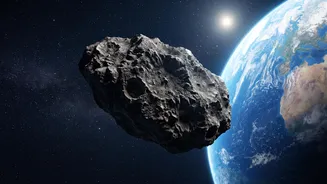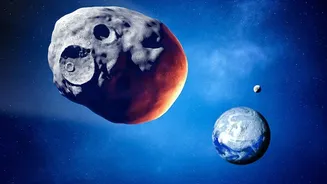






It turns out Earth’s long-term relationship with the Moon isn't exclusive. Our planet frequently hosts temporary companions, and the latest visitor, 2026 QQ8, is about to end its stay, reminding us of the dynamic dance of gravity in our cosmic neighbourhood.
What is a 'Temporary Moon'?
The term ‘temporary moon’ or ‘mini-moon’ is an unofficial nickname for a small asteroid that gets briefly captured by Earth's gravity. Unlike our large, permanent Moon which is locked in a stable orbit, these mini-moons are just passing through. Imagine a small stone getting caught in a river's eddy for a few loops before being pulled back into the main current. That’s essentially what happens to these asteroids. They are temporarily bound to Earth, making a few orbits before the gravitational pulls of the Sun and our own Moon eventually nudge them back into an orbit around the Sun. On average, there is likely at least one such object, about a metre in size, circling our planet at any given time.
Introducing 2026 QQ8
The newest member of this exclusive club is 2026 QQ8, a tiny asteroid only about two metres (or six feet) in diameter. According to reports, it was captured by Earth's gravity in April 2026 and was officially named by the International Astronomical Union's Minor Planet Center in late October. Discovering such objects is a challenge; they are incredibly small and dim, and they move quickly across the sky. It often takes weeks of observation to confirm that a new speck of light is a natural object and not a piece of old space junk or a defunct satellite.
The Difference from a 'Quasi-Satellite'
The term 'temporary moon' is often used interchangeably with 'quasi-satellite', but they describe different phenomena. A temporary or 'mini-moon' like 2020 CD3 is truly captured by Earth's gravity and orbits our planet for a short time. A quasi-satellite, however, is not gravitationally bound to Earth. Instead, it orbits the Sun on a path so similar to Earth's that it stays close to us for long periods. It's like two runners on a track with almost identical speeds; from our perspective, the other runner seems to be circling us, but they are both just running around the same track. Kamoʻoalewa (also known as 2016 HO3) is a famous example of a quasi-satellite that will remain a companion to Earth for centuries.
An Unstable Dance with Gravity
The orbit of a temporary moon like 2026 QQ8 is inherently unstable. While it is temporarily under Earth's influence, it is still subject to the immense gravitational pull of the Sun, which is much stronger. Add to that the constant tug from our large permanent Moon, and the delicate balance can't last. These combined forces perturb the tiny asteroid's path, eventually giving it the push it needs to break free from Earth's Hill sphere—the region of space where our planet's gravity is dominant. It’s a chaotic three-body problem that almost always ends with the smallest object being flung back out into its own solar orbit.
When Will It Leave?
Astronomers predict that 2026 QQ8 will not be with us for much longer. Its short stint as Earth's companion is expected to end in early December 2026, when it escapes our gravitational pull and continues on its journey around the Sun. There's no need to worry about its departure or a potential impact. Given its small size, even if it were on a collision course, it would safely break up and burn in the atmosphere, creating at best a bright meteor. Its visit is just another example of the fleeting, fascinating interactions happening in our solar system.
Earth's Other Visitors
2026 QQ8 is far from the first temporary moon we’ve spotted. In 2006, asteroid 2006 RH120 spent about a year in orbit before departing. More recently, 2020 CD3, another car-sized object, orbited Earth for about three years before it left in 2020. These discoveries are becoming more common as our sky-surveying technology improves. Scientists study these objects for several reasons. They provide a real-world laboratory for understanding orbital mechanics and the complex gravitational dance between planets, moons, and asteroids. Furthermore, they give us valuable insight into the population of near-Earth objects, helping us to better catalogue our cosmic neighbours.