




Who is Anil Menon?
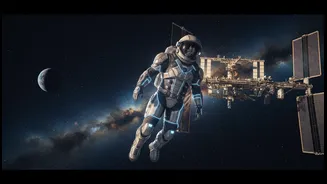
Anil Menon, a colonel in the US Space Force and an emergency physician, is a true child of a globally connected world. Born in Minneapolis, Minnesota, to an Indian father from Kerala and a Ukrainian immigrant mother, his background mirrors the very essence
of international collaboration. Before being selected by NASA in 2021, Menon's career was a testament to service in extreme environments. He served as a frontline physician for the US Air Force in Afghanistan, provided medical care to climbers near Mount Everest, and was a Rotary Scholar in India supporting polio vaccination efforts. His path to becoming an astronaut also included a crucial role at SpaceX, where he was the first flight surgeon, helping to build the company's medical program and prepare for its historic first human flights. This unique blend of medical expertise, military discipline, and private-sector innovation makes him an ideal crew member for a long-duration mission.
A Mission of Science and Diplomacy
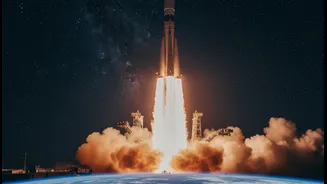
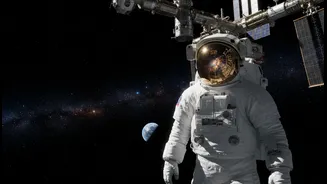
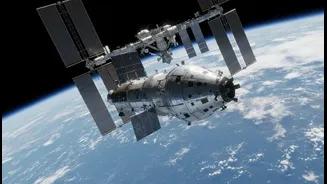
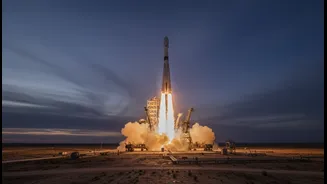
On July 14, 2026, Menon launched from the Baikonur Cosmodrome in Kazakhstan aboard a Russian Soyuz MS-29 spacecraft, alongside two Roscosmos cosmonauts, Pyotr Dubrov and Anna Kikina. This in itself is a powerful statement. Despite geopolitical tensions on Earth, the long-standing US-Russia seat exchange program continues, ensuring that both American astronauts and Russian cosmonauts have a presence on the International Space Station (ISS). The ISS, a joint project between five space agencies from the US, Russia, Europe, Japan, and Canada, has been a beacon of peaceful cooperation for over two decades. Menon's mission, which is expected to last about eight months until April 2027, will see him and his crewmates join a multinational team aboard the orbiting laboratory. His presence on a Russian spacecraft highlights the functional necessity of this partnership, which has weathered diplomatic storms to keep the collaborative spirit of the ISS alive.
Pushing the Boundaries of Research
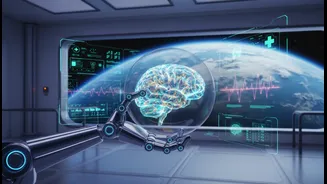
Aboard the station, Menon's work will be critical for the future of human spaceflight. As a physician-astronaut, he is uniquely qualified to lead experiments on the physiological effects of long-duration space travel. His research will examine how microgravity impacts blood flow, vein structure, and blood composition, knowledge essential for protecting astronauts on future missions to the Moon and Mars. Beyond human health, Menon will work on cutting-edge technology demonstrations. This includes testing AI-assisted ultrasound and augmented reality to allow for autonomous medical care in deep space, and studying how high-performance semiconductor crystals can be manufactured in microgravity. This research could lead to breakthroughs in computing, AI, and medical devices back on Earth.
A Symbol of the US-India Space Bridge
While Menon is a NASA astronaut representing the United States, his Indian heritage carries deep symbolic weight. His mission comes at a time when space cooperation between the US and India is reaching new heights. Following India's signing of the Artemis Accords—a set of principles for peaceful lunar exploration—the two nations have accelerated their partnership under initiatives like iCET (Initiative on Critical and Emerging Technology). This collaboration includes plans for a joint mission to the ISS involving Indian astronauts and the launch of the NASA-ISRO Synthetic Aperture Radar (NISAR) satellite, designed to track changes on Earth's surface. Menon's journey is a living embodiment of this growing bond. His family roots trace back to Palakkad in Kerala, a district that now boasts connections to three astronauts, including his wife Anna Menon, a private astronaut. His flight, carrying drawings by Indian schoolchildren, becomes a cultural as well as a scientific exchange.