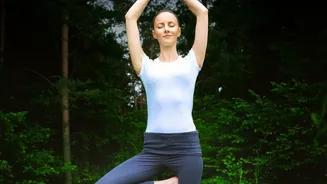



Mountain Pose, or Tadasana, is the foundation for all standing yoga postures. But its power lies in subtle details. Mastering how your shoulders and spine align in this pose can transform your practice, improving posture and stability.
More Than Just Standing
On the surface,
Mountain Pose (Tadasana) looks simple—it’s just standing on a mat. Yet, this fundamental posture is a highly active and intricate pose that teaches body awareness, improves posture, and strengthens the entire body. It's considered a 'blueprint' because the principles of alignment you learn in Tadasana are carried into almost every other pose. When you learn to properly stack your joints and engage your muscles with intention in this still position, you build a safer and more stable foundation for your entire yoga practice.
Understanding the Neutral Spine
A 'neutral spine' refers to the natural and most optimal alignment of your spinal column. Your spine isn't meant to be perfectly straight; it has three gentle, healthy curves: a slight inward curve at your neck (cervical), an outward curve at your upper back (thoracic), and another inward curve at your low back (lumbar). This structure is designed to absorb shock and provide a balance of stability and mobility. Maintaining this neutral alignment causes the least amount of stress on the vertebrae and surrounding muscles, allowing your skeleton to support you efficiently. In Tadasana, finding this alignment is key to preventing strain and cultivating a sense of length.
Finding Your Neutral Spine in Tadasana
To find your neutral spine, start by standing with your feet either together or hip-width apart. Distribute your weight evenly across all four corners of both feet. Imagine your pelvis is a bowl of water; you don't want to spill it forward (creating an over-arched low back) or backward (tucking the tailbone too much and flattening the low back). Gently tilt your pelvis back and forth a few times to find the midpoint where the bowl is level. Engage your core by drawing your lower belly in and up, which helps to support and lengthen the lower back. Finally, imagine a string pulling the crown of your head toward the ceiling, creating space between each vertebra.
The Role of Shoulder Position
Just as the pelvis affects the lower spine, the position of your shoulders profoundly impacts your upper back, neck, and even your breath. Many people carry tension in their shoulders, causing them to hunch forward or creep up toward the ears. In Tadasana, the goal is to counter this habit. Actively roll your shoulders up toward your ears, then back, and finally let them relax down your back. This action helps to broaden the collarbones and open the chest. Your arms can hang by your sides with palms facing forward. This external rotation of the arms encourages the shoulders to settle into a more open and stable position, which can improve posture and allow for deeper, more efficient breathing.
Common Mistakes to Avoid
Perfecting Tadasana is about avoiding common misalignments. One is locking the knees, which puts strain on the joints; always keep a micro-bend in them. Another is collapsing into one hip or leaning your weight onto your heels or the balls of your feet. In the upper body, watch for a collapsed chest or, conversely, puffing the ribs forward, which takes the spine out of neutral. The most common errors related to our focus are letting the shoulders round forward, which contributes to a slouched posture, or aggressively pulling the shoulder blades together, which creates tension. The key is to find an active but relaxed state where every part of the body is mindfully placed.