




First Steps: Do No Harm
You’ve stumbled upon a strange, heavy rock with a dark, often black, crust. It might be a meteorite. Before you do anything else, pause. The primary goal is to preserve the meteorite's scientific integrity. Meteorites carry invaluable information about
the formation of our solar system. Handling them incorrectly can introduce contamination and degrade the sample. NASA and other scientific bodies have clear guidelines: avoid touching the rock with your bare hands. The oils and microbes on your skin can contaminate the surface, promote rust, and compromise future analysis, especially for rare carbonaceous types. The meteorite itself is not harmful to you, but you can easily be harmful to it. So, take a moment to observe before acting.
Location, Location, Location
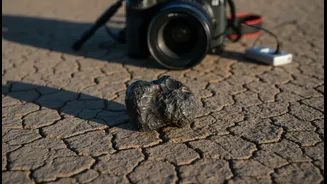
The single most important piece of data you can collect is the exact location of the find. Before you even think about moving the rock, document its position. Use your smartphone's GPS to record the precise coordinates. If GPS isn’t available, note the location on a map as accurately as possible, referencing permanent landmarks. Take several photos of the rock in the exact spot you found it, before it’s disturbed. Include an object like a coin or your phone in the picture to provide a sense of scale. This contextual information is vital for scientists to reconstruct the meteorite's fall and understand its journey, and helps distinguish it from terrestrial rocks.
Record the Time and Sights
If you were lucky enough to witness the meteorite fall as a fireball, your observations are priceless. Note the exact time of the event. Record the direction you were facing and the path the fireball took across the sky, including where it disappeared from view. Details about its brightness, shape, and any sounds you heard are also incredibly useful for researchers. Even if you didn't see the fall, recording the date and time of your discovery is still a critical piece of the documentation puzzle. This timeline helps scientists determine how long the meteorite has been on Earth and exposed to its atmosphere, which affects its condition.
Assess the Condition (Visually)
A fresh meteorite often has a thin, black, glassy layer called a fusion crust, formed when its surface melted during its fiery descent through the atmosphere. Look for this feature. Note if the crust is complete or broken. The interior of a stony meteorite is often a different color, usually light grey, and may show small, bright metallic flakes. A key feature in many stony meteorites is the presence of chondrules—tiny, spherical grains that formed in the early solar system and are not found in Earth rocks. Describe any visible cracks, rust spots, or unusual shapes. Avoid breaking the rock open to see the inside, as this should be done in a lab.
Handle with Extreme Care
Once you have thoroughly documented the scene, you can prepare to collect the sample. The best practice is to use a fresh piece of aluminum foil to pick it up and wrap it. You can also use clean tongs or powder-free gloves. The goal is to create a barrier between your hands and the rock. After wrapping it in foil, place the meteorite in a clean, dry zip-lock bag. To protect it from humidity, you can add a desiccant package to the bag, but make sure it doesn’t directly touch the foil-wrapped specimen. If the meteorite was found in soil, collecting a small sample of the surrounding soil in a separate bag can also be helpful for analysis.
Reporting Your Find in India
In India, the Geological Survey of India (GSI) is the official custodian of all meteorite finds. The GSI has been designated as the nodal agency for the collection, preservation, and research of all meteorites found within the country's borders. If you believe you have found a meteorite, you should report it to the GSI or local district authorities, who can then contact the GSI. All finds are meant to be registered in the National Meteorite Repository of India, which is maintained by the GSI in Kolkata. While meteorite ownership laws vary globally, in India there is a strong government interest in ensuring these rare objects are made available for scientific study.