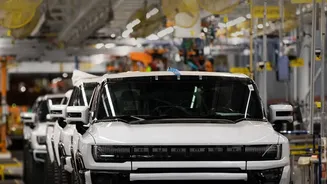








Tesla's polarizing Cybertruck will remain in production longer than expected. CEO Elon Musk announced an extension through summer 2027, giving the company a few more months to work through a massive backlog of orders before a planned factory pivot.
A Strategic Shift, Not a Reversal
The
decision to extend Cybertruck production is a minor adjustment to a much larger strategic shift for Tesla. Earlier in November 2026, Elon Musk announced that the company would wind down Cybertruck manufacturing at its Gigafactory in Texas around the middle of 2027. The newly announced extension pushes that end date back by a few months, to the end of summer 2027. The primary reason, according to Musk, is to fulfill more of the vehicle's substantial order backlog, which he stated 'far exceeds' the company's production rate. However, the core plan remains unchanged: Tesla intends to dismantle the Cybertruck line to free up factory space and resources for its next major priority, the autonomous 'Cybercab' robotaxi.
Demand, Difficulty, and Disappointment
The Cybertruck's story has been one of extreme highs and lows. After its unveiling in 2019, it amassed a huge number of pre-orders. However, bringing the radical, stainless-steel vehicle to mass production has been fraught with what Musk himself called 'enormous challenges'. Since deliveries began in late 2023, the production ramp-up has been slow, plagued by the complexities of its unique design and manufacturing process. Sales figures have fallen drastically short of Musk's initial ambitious projections of 250,000 units per year. Recent estimates put 2025 sales at around 20,000 units, a nearly 48% drop from the previous year, highlighting a significant gap between initial hype and market reality. This performance, coupled with several recalls, has led to the strategic pivot away from the electric pickup.
What This Means for Buyers
For the thousands of customers still in the queue, the extension offers a glimmer of hope. In the days following the initial wind-down announcement, Musk acknowledged that Tesla would 'have to return deposits for a lot of people' because it would be impossible to build every truck ordered. Adding an extra production shift and extending the timeline through summer 2027 is a direct attempt to mitigate this and satisfy more patient reservation holders. However, it does not guarantee a vehicle for everyone. Even before the announcements, wait times for new orders of the base model were already stretching into 2027. In a move to simplify the final production run, Tesla has also stopped taking orders for lower-tier trims, leaving only the top-of-the-line 'Cyberbeast' model available for new configurations.
The Robotaxi Future
The decision to end Cybertruck production is ultimately not about the truck's failure, but about what Tesla sees as a bigger opportunity. Musk has explained that the 'opportunity cost' of the Cybertruck's complexity is too high when weighed against the potential profits from ramping up the Cybercab. This reflects a significant evolution in Tesla's corporate identity, moving from being just a car manufacturer to a leader in autonomous mobility and robotics. By freeing up capacity at its main Texas plant, Tesla is betting that a fleet of self driving taxis will generate more long term value than a niche, albeit iconic, electric pickup. The Cybertruck, a vehicle that looked like the future, is officially making way for Tesla's next vision of it.