


A Flight of Historic Ambition
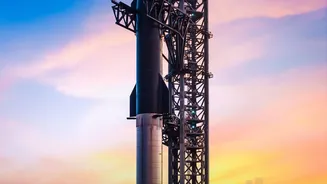
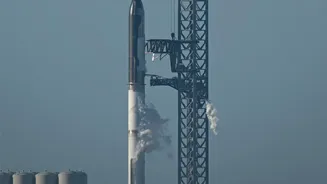
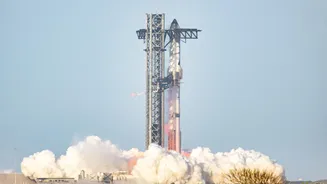
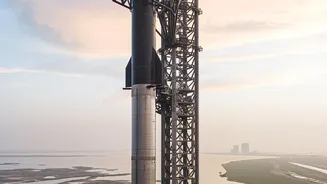
On Friday, November 13, 2026, the 15th test flight of SpaceX's Starship system lifted off from Starbase, Texas, with a set of audacious goals. The mission's centrepiece was an attempt at a 'double catch': recovering both the Super Heavy booster and the Starship upper
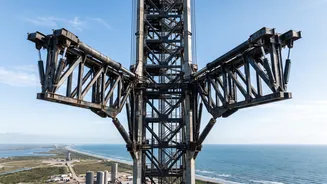
stage using the launch tower's giant mechanical 'chopstick' arms. This had never been attempted before in a single mission and represented a monumental leap towards a fully and rapidly reusable launch system, the core of SpaceX's business model. The integrated rocket, the largest ever built, soared into the sky in a seemingly flawless ascent, successfully separating its two stages minutes into the flight. The Starship upper stage continued on its primary mission, while the Super Heavy booster began its journey back to Earth.
Setback for the Super Heavy Booster
The first critical phase of the recovery did not go to plan. The Super Heavy booster was meant to return to the launch tower for a controlled catch just minutes after launch. However, an issue prompted the booster's autonomous systems to abort the maneuver. Instead of heading for the tower's arms, the vehicle redirected itself for a splashdown in the Gulf of Mexico. Early reports from SpaceX indicated the guidance, navigation, and control (GNC) system detected an anomaly, triggering the abort as a safety precaution. Another report suggested a low fuel mass alarm may have ended the boostback burn early. The booster then performed a landing burn over the water before its flight termination system was activated, resulting in an explosion near the surface. While the loss of the booster and its 33 Raptor engines is a significant setback, the successful abort maneuver demonstrated that the system could safely divert itself when a landing is not viable, providing crucial data for future attempts.
A Spectacular Catch for Starship
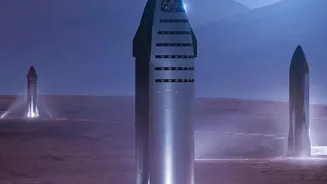
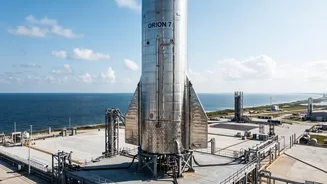
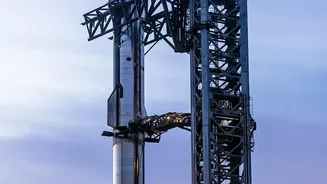
While the booster's recovery failed, the Starship upper stage, known as Ship 42, continued to a spectacular success. After achieving orbit, it deployed 26 next-generation Starlink satellites. The spacecraft then spent over 22 hours in space, completing 14 orbits of Earth. On Saturday, November 14, the world watched as Starship performed a controlled reentry, descending through the atmosphere before reigniting its engines to slow for a pinpoint landing. In a historic first for rocketry, the 'Mechazilla' tower arms successfully closed around the descending vehicle, catching an orbital-class spacecraft for the first time. This achievement is a monumental step forward, proving that the most expensive part of the launch system can be brought back from orbit for reuse with minimal refurbishment.
What This Means for SpaceX
Analysts have described the Flight 15 mission as a major 'de-risking event' for SpaceX, despite the loss of the booster. The successful catch of the Starship upper stage is widely seen as the more difficult and critical achievement, validating a core pillar of the company's long-term vision. This success keeps NASA's Artemis program, which relies on a version of Starship to land astronauts on the Moon, on track. The ethos at SpaceX is to test, fail, learn, and fly again quickly. The aborted booster catch, while a failure to meet the primary objective, provided invaluable data on the vehicle's performance and abort systems. The company has successfully caught three Super Heavy boosters on previous flights, proving the concept is sound. The focus will now be on understanding the cause of the Flight 15 anomaly and implementing fixes for the next attempt. Every flight, successful or not, moves SpaceX closer to its goal of making humanity a multi-planetary species.