





Why the Wall Sit is Your New Best Friend
The modern workday can be tough on our bodies. Long hours spent sitting can lead to weak glutes, tight hips, and a general feeling of lethargy. While a full gym session is ideal, it’s not always realistic. This is where the wall sit comes in. It’s an isometric
exercise, meaning you hold a static position to create tension in the muscles. It requires no equipment—just a sturdy wall—and can be done in minutes, making it the perfect fitness snack during a busy day. While 'effortlessly' might be a stretch (you'll definitely feel the burn!), its simplicity and convenience are unmatched for sneaking in a workout between meetings.
The Powerful Benefits of This Simple Move
Don't let its simplicity fool you; the wall sit is a powerhouse. Its primary job is to build muscular endurance in your lower body. The sustained contraction targets your quadriceps (the front of your thighs), but also engages your glutes, hamstrings, and even your calves as they work to stabilise you. This isn't just about 'toning'; it's about building functional strength that supports your knees, improves your stability, and can even help with posture by encouraging you to engage your core. Holding the position also tests your mental grit, making it a great exercise for both body and mind. It's a low-impact move, which means it’s gentle on your joints compared to exercises like running or jumping.
How to Perform the Perfect Wall Sit
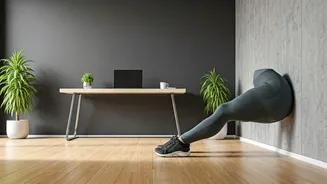
Getting the form right is crucial for maximising benefits and preventing strain. Follow these steps for a flawless wall sit: 1. **Find Your Wall:** Stand with your back against a smooth, flat wall. 2. **Position Your Feet:** Walk your feet out about two feet in front of you. They should be shoulder-width apart and flat on the floor. 3. **Slide Down:** Slowly slide your back down the wall until your thighs are parallel to the floor, as if you're sitting in an invisible chair. Your knees should be directly above your ankles, forming a 90-degree angle. 4. **Check Your Form:** Ensure your back is flat against the wall—from your head to your lower back. Your weight should be evenly distributed through your heels. 5. **Engage and Hold:** Brace your core, keep your chest up, and look straight ahead. Hold this position for your target time. Breathe steadily throughout the exercise; don't hold your breath.
Common Mistakes to Avoid
A few small errors can reduce the effectiveness of your wall sit or even cause injury. Be mindful of these common mistakes: * **Sliding Too Low:** Going below a 90-degree angle at your knees puts unnecessary pressure on them. Keep your thighs parallel to the floor. * **Knees Caving Inward or Past Toes:** Your knees should track directly over your ankles. If they extend past your toes, you're putting your knee joints at risk. Walk your feet further from the wall if needed. * **Arching Your Back:** Make a conscious effort to keep your entire back, especially your lower back, pressed firmly against the wall. This engages your core and protects your spine. * **Leaning on Your Thighs:** Don't rest your hands or elbows on your legs. Let your muscles do the work! You can cross your arms over your chest or let them hang by your sides.
Your Desk Break Wall Sit Routine
Ready to get started? The key is consistency, not intensity. Instead of one long, gruelling session, aim for short bursts throughout your day. Here’s a simple routine to build into your work schedule: * **The Goal:** Aim for 2-3 wall sit 'breaks' per day. * **Beginner Level:** Start by holding the position for 20-30 seconds. Rest for 30 seconds, and repeat 3 times. * **Progression:** As you get stronger, increase the hold time. Work your way up to 45 seconds, then a full minute. Once you can comfortably hold for 60 seconds, you can add a challenge, like holding a book on your lap for extra weight or trying a single-leg variation for a few seconds at a time. Set a reminder on your phone or calendar. When it goes off, stand up, find a wall, and take two minutes for your body. It’s a small investment with a big return.