






The dazzling dance of the aurora is one of nature’s most breathtaking spectacles. But behind the beautiful curtains of light lies a complex process that can have profound impacts back on Earth, with new research showing a direct link to our power grids.
From Solar Wind to Auroral Light
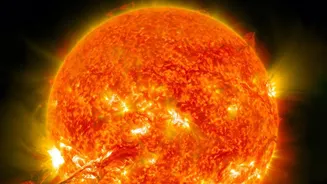
The story begins with the Sun, which constantly sends out a stream of charged particles known as the solar wind. Sometimes, the Sun releases a much more intense burst of energy and matter called a coronal mass ejection (CME). When this cloud of particles reaches Earth, it interacts with our planet's magnetosphere, a protective magnetic bubble. This interaction can trigger a series of events, the most visually stunning of which are auroras. However, these events also include shorter, more intense disturbances known as auroral substorms. A substorm is an explosive release of energy from the Earth's magnetotail—the part of the magnetosphere stretched out away from the Sun. This energy release accelerates charged particles into our upper atmosphere, where they collide with oxygen and nitrogen atoms to create the vibrant, dancing lights of the aurora.
The Groundbreaking New Connection
For a long time, scientists understood that large-scale geomagnetic storms, which can last for days, posed a threat to ground-based infrastructure. A new study, however, has drawn a much faster and more direct line from space to the ground. The research demonstrates that even a single, relatively short auroral substorm, which can last from one to three hours, can cause rapid and significant changes at ground level within minutes. While the beautiful lights appear high in the atmosphere, the same process that creates them also drives powerful electrical currents in the ionosphere. Recent findings show that rapid variations in these atmospheric currents induce corresponding magnetic field fluctuations right at the Earth's surface. This provides a crucial piece of the puzzle, connecting the explosive energy release in the magnetotail directly to tangible effects under our feet.
How Space Weather Causes Blackouts
The 'rapid changes at ground level' are not just a scientific curiosity; they are the root cause of geomagnetically induced currents (GICs). When the Earth's magnetic field fluctuates rapidly, it creates an electric field on the surface. This electric field can drive uncontrolled, quasi-DC electrical currents into any long conducting networks, such as power transmission lines, pipelines, and railway systems. These GICs are the real menace. They flow into the neutral grounding points of high-voltage transformers, the backbone of any electrical grid. The unwanted current can cause the transformer's magnetic core to saturate, leading to overheating, increased reactive power demand, and harmonic distortions that can trip protective relays and, in severe cases, cause permanent damage to the transformer. Since large power transformers are expensive and can take months or even years to replace, a widespread GIC event could lead to prolonged blackouts.
Assessing the Risk to India's Grid
While auroral displays are typically seen at high latitudes, the magnetic disturbances from a severe storm can extend much further. India's power grid, which is rapidly expanding to accommodate renewable energy sources, is not immune to these threats. The country's increasing reliance on long transmission lines to carry power from solar farms in regions like Rajasthan to population centres makes the grid inherently more susceptible to GICs. Furthermore, the geology of a region plays a role; areas with poor ground conductivity can experience larger GIC effects. Past incidents, such as the 1989 blackout in Quebec, which was caused by a geomagnetic storm, serve as a stark warning. Research has already noted the vulnerability of India's northern grid to solar activity. As our dependency on a stable electricity supply deepens for everything from healthcare to finance, understanding and preparing for these low-frequency but high-impact events is becoming critical.
Building a More Resilient Future
This new understanding of the rapid impact of substorms is a vital wakeup call. It improves forecasting models, potentially giving grid operators more timely warnings to take protective measures. Mitigation strategies are available. These include installing GIC blocking devices in transformer neutrals, developing more robust transformer designs, and enhancing real time monitoring of both space weather and GIC flows within the grid. For grid operators it means reassessing operational procedures to manage voltage stability during a geomagnetic disturbance. For policymakers and infrastructure planners in India it highlights the need to factor in space weather resilience as the national grid continues its expansion. By protecting critical transformers and enhancing grid flexibility it is possible to maintain the grids integrity even during a significant solar event.