



A Cosmic Rainstorm
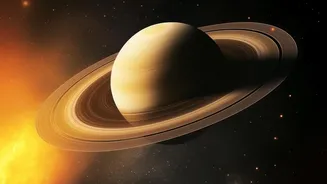
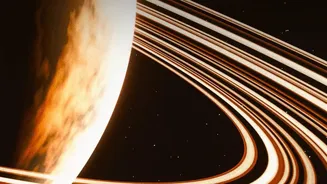
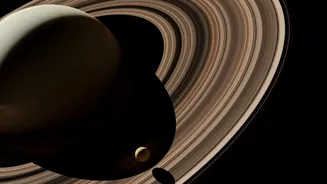
The demise of Saturn's rings is a slow, graceful exit. The primary culprit is a phenomenon known as 'ring rain'. Particles of water ice, ranging from tiny grains to larger chunks, are constantly being pulled from the rings by Saturn's gravity and magnetic
field. As these charged particles spiral down into the planet's upper atmosphere, they effectively create a continuous, massive rain shower over specific latitudes. Data from NASA's Cassini spacecraft and the Keck Observatory confirmed this process, revealing that the amount of water falling onto Saturn could fill an Olympic-sized swimming pool every half hour. Based on this rate of loss, scientists estimate the rings have a finite lifespan, potentially vanishing completely in the next 100 million years. This might seem like a long time, but on a cosmic scale, it’s incredibly brief, suggesting we are lucky to see them at all.
The Legacy of Cassini
Much of what we know about the rings' impending doom, and Saturn itself, comes from the Cassini-Huygens mission. A joint project of NASA, the European Space Agency, and the Italian Space Agency, Cassini orbited Saturn for 13 years, from 2004 to 2017. Its instruments provided unprecedented insights. During its final, daring orbits, Cassini dived between the planet and its rings, allowing scientists to measure the mass of the rings for the first time. This measurement helped determine that the rings are surprisingly young—likely no more than 400 million years old, a mere fraction of Saturn's 4.5-billion-year existence. The mission revealed the dynamic nature of the ring system, finding that it's made of everything from dust grains to mountain-sized objects, and that jets of water from the moon Enceladus actually supply material to the outermost E-ring. Cassini’s grand finale, a planned plunge into Saturn's atmosphere, gave us our first direct sampling of its chemical makeup.
A Planet of Unsolved Mysteries
Even without its famous rings, Saturn remains a world of profound scientific interest. The planet itself holds deep mysteries that missions have only begun to scratch. Its turbulent atmosphere features a bizarre, six-sided jet stream at its north pole, a hexagonal storm wider than Earth that has persisted for decades. The inner workings of this gas giant, its core composition, and the generation of its powerful magnetic field are still poorly understood. Scientists also want to understand the planet’s weather, including lightning storms and seasonal changes that unfold over its nearly 30-year orbit. The disappearance of the rings is a scientific event in itself, one that will fundamentally change the planet's upper atmosphere and ionosphere over millions of years. Studying this process gives us a unique laboratory for understanding planetary evolution.
The Next Generation of Exploration
The end of the Cassini mission left a void, but the exploration of the Saturn system is far from over. NASA is already moving forward with the Dragonfly mission, scheduled to launch in 2028. This revolutionary quadcopter-like drone will land on Saturn's largest moon, Titan, to explore its 'prebiotic' chemistry and methane lakes. While Dragonfly focuses on Titan, scientists are already planning for a return to the main planet. Concepts like the Saturn Probe Interior and Atmosphere Explorer (SPRITE) have been proposed to plunge deep into Saturn's atmosphere to analyze its composition and structure in ways Cassini could not. Lessons learned from Cassini are also directly influencing missions to other 'ocean worlds' in the outer solar system, like NASA's Europa Clipper. These future missions, building on Cassini's legacy, will ensure that even as its famous rings fade, Saturn will continue to be a source of wonder and discovery for decades to come.