





A Familiar Story in Madrid
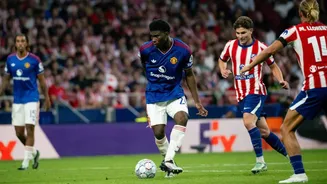
The script felt depressingly familiar. Manchester United conceded an early goal, with Pablo Barrios finding the net within the first minute as the defence was sliced open with ease. For a team already low on confidence, it was the worst possible start.
Despite creating a few chances, they were largely second-best. The match was effectively settled in the 74th minute when defender Leny Yoro received a controversial red card. Atletico, clinical and organized, capitalized just five minutes later through Ademola Lookman to seal the victory. While the red card will be debated, the team's inability to cope with adversity and the subsequent collapse pointed to problems that run far deeper than one refereeing decision. It was a performance that encapsulated a team lacking resilience and a coherent plan.
A Team Without a Plan
Under manager Michael Carrick, United have repeatedly looked like a collection of talented individuals rather than a cohesive unit. Against Atletico, this was painfully evident. There was no discernible pattern of play, and the midfield often looked disjointed, unable to control the game's tempo. Tactical analysts have noted that the team often looks devoid of ideas and structure, especially under pressure. The reliance on moments of individual brilliance from players like Bruno Fernandes or Marcus Rashford is a fragile strategy that quickly unravels against a well-drilled opponent like Diego Simeone's Atletico. The red card simply exposed the lack of a functional system underneath; there was no 'Plan B' because 'Plan A' itself seems so ill-defined. This tactical vacuum is not new but has become a chronic condition, leaving the team vulnerable and predictable.
Misfires in the Market
Many of the on-pitch problems can be traced back to a flawed and incoherent recruitment strategy over several years. The club has spent enormous sums on players who have failed to fit into a consistent tactical vision. Recent transfer windows have been criticized for lacking clear direction, with some suggesting the club has signed overpaid players who are not good enough for the standards expected at Old Trafford. The current squad is a patchwork of different managers' philosophies, resulting in an imbalanced and often disjointed team. For example, the club has been accused of failing to address obvious needs in midfield and defence while spending heavily on other areas. This scattergun approach has not only led to poor results but also financial inefficiency, with the club having one of the worst net spends in Europe over the last decade.
The Long Shadow of the Past
To truly understand how it got this bad, one must look back to 2013. Since Sir Alex Ferguson's retirement, Manchester United has been in a state of perpetual transition. A succession of managers—from David Moyes to Louis van Gaal, José Mourinho, and Ole Gunnar Solskjaer—have all tried and failed to restore the club to its former glory. Each brought a different philosophy, leading to constant changes in style and personnel, and preventing the club from building a long-term, sustainable identity. The 'culture of winning' that defined the Ferguson era has been replaced by a culture of inconsistency. The weight of the club's history now seems to burden the players rather than inspire them. This latest defeat is not an isolated incident but another chapter in a long, drawn-out story of a giant struggling to find its way back to the top.