

A New Eye on Distant Skies
The James Webb Space Telescope is the most powerful space observatory ever built, designed to peer deep into the cosmos with its advanced infrared instruments. One of its primary missions is to study exoplanets—worlds orbiting other stars. It does this
using a technique called transit spectroscopy. When an exoplanet passes in front of its star from our point of view, the starlight filters through the planet's atmosphere. By analysing how that light changes, astronomers can decipher the chemical makeup of the atmosphere, revealing the presence of gases like water, methane, and helium. This capability allows scientists to not only identify the ingredients for life but also to witness the dynamic and often violent processes shaping these distant worlds in real-time.
The Fragile Shield of an Atmosphere
A planet's atmosphere is a crucial ingredient for habitability. It provides air to breathe, regulates temperature, and shields the surface from harmful radiation. But atmospheres are not permanent. Planets, especially those orbiting very close to their stars, can have their atmospheres stripped away over millions of years. This process, known as atmospheric escape, is driven by the intense heat and radiation from the host star, which can energise atmospheric gases to the point where they fly off into space. Understanding this process is vital because it helps define the true boundaries of a star system’s habitable zone. A planet might be in the right location to have liquid water, but if its star is too active and has stripped its atmosphere, the chances for life are virtually zero.
A Case Study in Atmospheric Bleeding
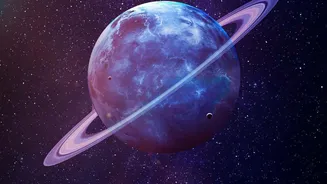
Recent JWST observations have provided a stunning example of this phenomenon. The telescope was pointed at WASP-107b, a low-density gas giant known as a “super-puff,” located about 200 light-years away. Scientists witnessed the planet's atmosphere bleeding helium into space at a dramatic rate. The observations were so detailed that they revealed a massive tail of escaping gas stretching nearly ten times the planet's own radius. This was the most confident detection of this process ever recorded, showing gas not just trailing the planet, but also moving ahead of it in its orbit. For worlds like WASP-107b, which are extremely close to their stars, this atmospheric stripping is a powerful and destructive force, essentially boiling the atmosphere away over eons.
Redefining the 'Goldilocks Zone'
These findings force a rethink of the classic “Goldilocks Zone”—the orbital band around a star where temperatures are just right for liquid water. Proximity to a star isn't the only factor. The star's age, temperature, and radiation output are just as critical. A planet in a seemingly perfect location could be uninhabitable if it orbits a star that is particularly violent, stripping away its protective atmospheric blanket. By studying planets that are losing their atmospheres, like WASP-107b, and others that may have already lost them entirely, like the rocky super-Earth GJ 1252 b, JWST is providing crucial data points. It's helping astronomers build a more nuanced model of habitability, one that accounts for the complex interplay between a planet and its star. This effectively sharpens the search for life, allowing scientists to better prioritise which of the thousands of known exoplanets are the most promising targets for follow-up studies.