



A Celestial Show Decades in the Making
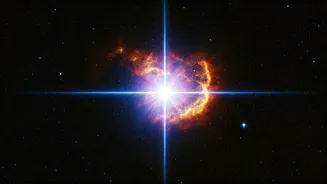
In the vast, quiet expanse of space, something truly remarkable is about to happen. A star system known to astronomers as T Coronae Borealis is predicted to undergo a dramatic and brilliant explosion, making it temporarily visible from Earth without a telescope.
This isn't just any star; it's a 'recurrent nova,' a celestial object that flares up on a semi-regular schedule. For T Coronae Borealis, that schedule is roughly every 80 years. The last time it graced our skies was in 1946, making this year's anticipated event a truly once-in-a-lifetime viewing opportunity for most people alive today.
Nova, Not Supernova: What's the Difference?
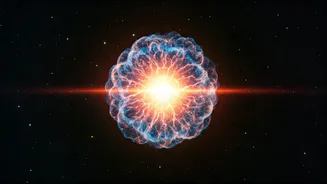
While the headline hints at a supernova, what's happening with T Coronae Borealis is technically a nova—a powerful but not terminally destructive event. A supernova is the cataclysmic death of a massive star. A nova, on the other hand, occurs in a binary star system where two stars are locked in a cosmic dance. In this case, a small, dense star called a white dwarf is orbiting a much larger red giant. The white dwarf's intense gravity pulls material—mostly hydrogen—from its larger companion. Over decades, this stolen gas builds up on the white dwarf's surface, like air being pumped into a balloon. Eventually, the pressure and temperature become so extreme that it triggers a runaway thermonuclear explosion. This explosion is what we see as the nova, a sudden and immense brightening of the star.
When and Where to Look Up
Astronomers are confident the event will occur, but the exact timing is unpredictable. The current forecast window is broad, stretching from now until September 2024. When it happens, the nova will appear as a 'new' star in the night sky. To find it, you'll need to locate the constellation Corona Borealis, or the 'Northern Crown.' It’s a small, C-shaped arc of stars located between the larger constellations of Boötes and Hercules. For observers in India and the rest of the Northern Hemisphere, this constellation is best viewed during the summer months. The nova is expected to reach a magnitude of +2, which is about the same brightness as Polaris, the North Star. It will be visible to the naked eye for a few days and with binoculars for about a week before fading back into obscurity for another 80 years.
The Story of the 'Blaze Star'
T Coronae Borealis isn't a new discovery. It has been documented erupting twice before in modern history: once in 1866 and again in 1946. This reliable recurrence is what makes astronomers so certain it's due for another show. Each eruption provides a fresh wave of data, and this time, we have technology that astronomers of the 1940s could only dream of. The James Webb Space Telescope, along with countless other ground and space-based observatories, will be watching closely. These observations allow scientists to test their models of how stars interact and evolve. For astronomers, this isn't just a pretty light in the sky; it's a natural laboratory for studying the fundamental physics of the universe.
Why This Event Matters
Beyond the sheer spectacle, this nova is a powerful reminder of the dynamic and ever-changing nature of the cosmos. We often think of the stars as fixed and eternal, but events like this show us that the universe is a place of constant activity. For the average person, it's a rare chance to connect directly with an astronomical phenomenon. You won't need expensive equipment or a degree in astrophysics—just a clear night, a little patience, and knowledge of where to look. It’s an invitation to step outside, look up, and witness a cosmic cycle that has been unfolding for millennia, connecting us to the same sky that our grandparents and great-grandparents watched.