



The Sun's Enduring Riddle
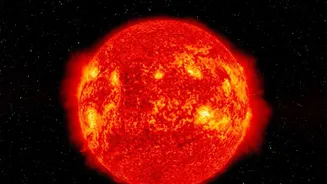
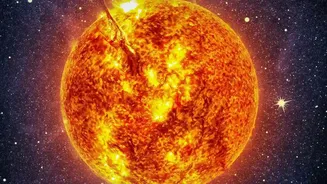
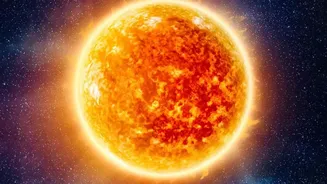
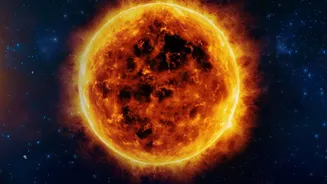
For decades, astrophysicists have been puzzled by the coronal heating problem. The Sun's visible surface, the photosphere, sizzles at a formidable 5,500 degrees Celsius. Logic would suggest that moving away from this heat source should lead to cooler
temperatures. Yet, the Sun's outer atmosphere, the corona, boasts a temperature of over a million degrees. This defiance of simple thermodynamics has been a central mystery in solar physics since it was first identified in 1939. How is energy being pumped from the cooler surface to superheat the tenuous plasma of the corona miles above it?
A New Wave in the Spotlight
Recent discoveries are providing powerful evidence for one of the leading theories. Using the Daniel K. Inouye Solar Telescope in Hawaii, the world's most powerful solar telescope, scientists have captured images of the Sun's surface in unprecedented detail. These images, released in early August 2026, revealed swirling vortices and wave-like patterns at the edges of solar granules—the bubbling structures of plasma on the photosphere. These patterns are the signature of a phenomenon known as the Kelvin-Helmholtz instability, which occurs when two fluids, or in this case plasmas, move past each other at different speeds, creating a shear that grows into waves and vortices.
Magnetic Highways for Energy
These newly seen instabilities are believed to be a key part of the energy transport system. The theory of 'wave heating' proposes that the churning, boiling motions on the Sun's surface generate various types of magnetic plasma waves, such as Alfvén waves. These waves travel upwards along the Sun's magnetic field lines, which act like highways, carrying enormous amounts of energy from the surface into the corona. The process can be likened to cracking a whip; the energy travels along the length of the whip and is violently released at the tip. Similarly, these plasma waves travel up into the corona where they become unstable and 'break', depositing their energy as heat.
From Theory to Smoking Gun
For a long time, this wave heating idea was a promising theory but lacked direct, conclusive proof. While larger waves had been seen, observing the smaller, higher-frequency waves thought to be responsible for the bulk of the heating was beyond the capability of older instruments. The new, ultra-high-resolution images from the Inouye telescope, however, show these processes in action right at their source. Observing these instabilities provides a 'smoking gun', connecting the turbulent energy of the surface directly to the mechanisms that could heat the corona. It suggests that this constant roiling and shearing on the surface is what generates the waves that carry the energy to be deposited as heat in the atmosphere above.
Why This Matters For India and Earth
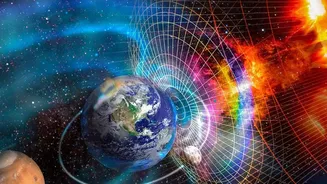
Understanding the corona isn't just an academic exercise. The same mechanisms that heat the corona also drive the solar wind, a constant stream of charged particles flowing from the Sun. Sudden releases of energy, like solar flares and coronal mass ejections, can supercharge this wind, creating space weather events that threaten satellites, power grids, and astronauts. By better understanding the fundamental physics of the Sun, we can improve our ability to predict this space weather. This global scientific effort includes significant contributions from India. For instance, scientists from the Aryabhatta Research Institute of Observational Sciences (ARIES) in Nainital have developed new methods for studying wave-driven heating, complementing the observational data from powerful new telescopes. Missions like India's Aditya-L1 solar observatory also play a crucial role in monitoring the Sun's large-scale activity, providing vital context to these new discoveries.