


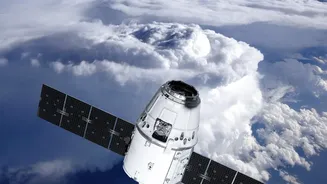
Why Venus? Earth's Cautionary Tale
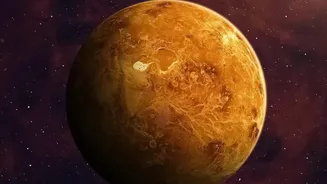
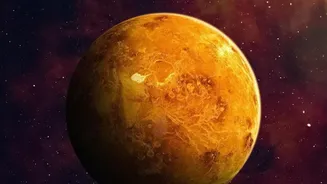
Venus and Earth are similar in size, mass, and density, leading scientists to believe they may have had similar origins. Yet, they evolved into dramatically different worlds. Venus suffers from a runaway greenhouse effect, with a thick atmosphere primarily
of carbon dioxide that traps heat, resulting in surface temperatures hot enough to melt lead, around 475°C. Its surface pressure is over 90 times that of Earth's, equivalent to being 900 meters underwater. By studying why our planetary neighbour took such a drastically different path, scientists hope to gain invaluable insights into climate change processes, which can help in modeling and understanding Earth's own climate future.
Peering Beneath the Veil
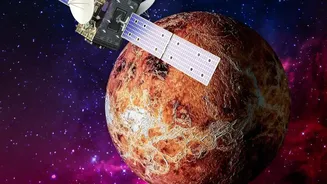
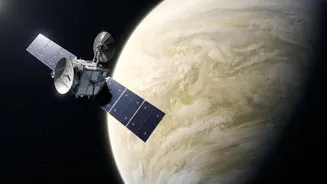
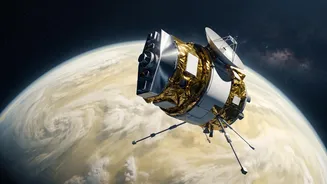
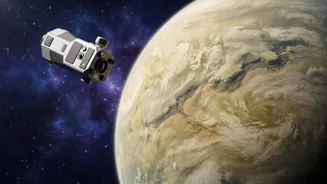
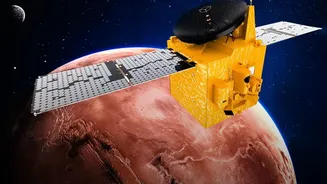
The primary objective of the Shukrayaan-1 mission, officially named the Venus Orbiter Mission (VOM), is to study the planet's surface and atmosphere in detail. The headline feature of Venus is its opaque blanket of clouds made of sulfuric acid, which makes direct observation of the surface impossible in visible light. To overcome this, ISRO will equip the orbiter with advanced instruments, most notably a high-resolution Synthetic Aperture Radar (SAR). This radar can penetrate the dense cloud cover, day or night, to map the Venusian surface with high precision. The mission also aims to be the first to conduct a subsurface study of Venus using a ground-penetrating radar, looking for clues about its geological history and structure.
A Suite of Sophisticated Instruments
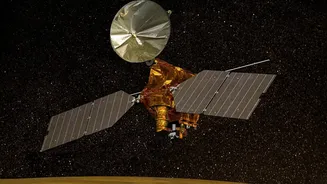
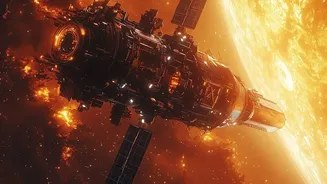
The orbiter is expected to carry a payload of about 100 kg, comprising 19 different scientific instruments. These include Indian-made payloads as well as collaborations with international space agencies from Russia, Sweden, and Germany. The scientific toolkit is designed for a comprehensive investigation. Key instruments will analyze the structure, composition, and dynamics of the atmosphere, investigate volcanic activity and lava flows, and study the interaction between the Venusian ionosphere and the solar wind. International contributions include the Venusian Neutrals Analyzer (VNA) from Sweden, which will study how solar particles interact with the planet's atmosphere.
The Next Frontier for ISRO
Following the historic success of the Chandrayaan missions to the Moon and the Mangalyaan mission to Mars, Shukrayaan-1 represents India's next major leap in interplanetary exploration. Approved by the Union Cabinet in September 2024 with a budget of approximately ₹1,236 crore, the mission is currently scheduled for launch on March 29, 2028, aboard ISRO's powerful LVM-3 rocket. The journey to Venus will take 112 days, with the spacecraft expected to enter orbit around the planet on July 19, 2028. To achieve its final, lower science orbit, the spacecraft will use a technique called aerobraking for the first time in an ISRO mission, using the friction of Venus's upper atmosphere to slow down over several months, conserving precious fuel. This mission will not only gather critical scientific data but also demonstrate ISRO's growing capabilities in executing complex deep-space projects.