






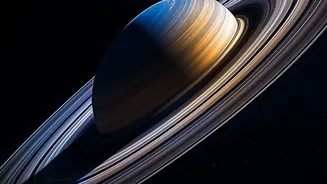
The Lord of the Rings Takes Centre Stage
Throughout August, Saturn will grow progressively brighter and more prominent, paving the way for its grandest appearance of the year. This annual event is called opposition, when Earth passes directly between the Sun and an outer planet. Although the exact
moment of opposition occurs on October 4, 2026, the entire period leading up to it provides a fantastic viewing window. This August, the gas giant rises earlier each night, climbing higher in the sky and offering a spectacular, steady, yellowish glow for observers. It's the perfect month for casual stargazers and seasoned astronomers alike to turn their attention to this celestial jewel.
A Celestial Alignment Explained
So what exactly is opposition, and why does it make Saturn a 'standout'? Imagine the solar system as a giant racetrack. Earth, on its faster inner track, 'overtakes' the slower, more distant Saturn about once a year. Opposition is the moment of that overtake. From our perspective, Saturn is on the opposite side of Earth from the Sun. This means two things for skywatchers: first, the planet rises in the east around sunset and remains visible all night long, setting in the west around sunrise. Second, it's the point in its orbit when Saturn is closest to Earth, making it appear at its biggest and brightest in our sky. This proximity is what turns it from a distant point of light into a must-see astronomical target.
How to Find Saturn This August
Finding Saturn is easier than you might think. As darkness falls, look towards the eastern horizon. Saturn will rise in the early part of the month around 11:30 PM, but by the end of August, it will be visible much earlier, around 10 PM. It will be located in the constellation Pisces. Unlike stars that twinkle due to atmospheric disturbance, planets like Saturn shine with a steady, unwavering light. Its distinct yellowish hue also helps it stand out from the surrounding stars. Throughout the night, it will track across the southern sky. For a special treat, look up on the nights of August 30-31, when the Moon will pass close to Saturn, offering a beautiful pairing.
Naked Eye, Binoculars, or Telescope?
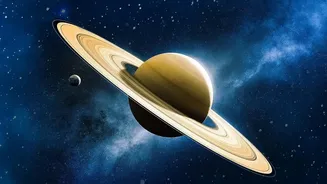
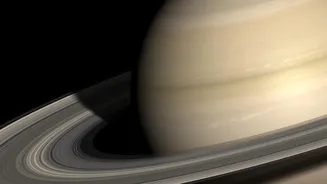
Saturn's beauty can be appreciated with varying levels of equipment. To the naked eye, it will appear as a very bright, non-twinkling 'star'. With a good pair of binoculars, you might be able to discern that the planet is not perfectly round, but slightly elongated—a hint of the famous rings. However, to truly witness the magic, you need a telescope. Even a small, basic telescope with 50x magnification is enough to clearly resolve the rings as a separate structure from the planet. With a slightly larger amateur telescope, you might even spot the Cassini Division—a dark gap in the rings—and Saturn's largest moon, Titan, appearing as a tiny star-like point nearby. After being nearly invisible in 2025 when they were edge-on to Earth, the rings are now tilting back into view, making 2026 a great year to observe them.
An August Sky Full of Wonders
While Saturn is the main event, August 2026 offers other celestial treats. The famous Perseid meteor shower peaks on the nights of August 12 and 13. This year’s display is perfectly timed with a new moon, meaning the sky will be dark and ideal for spotting shooting stars. In a clear, dark location away from city lights, you could see 50 to 100 meteors per hour. The main challenge for viewing in much of India will be the monsoon clouds, but if you get a clear night, it is an unmissable event. Additionally, a 'planet parade' will be visible in the pre-dawn sky, featuring Mars, Mercury, Jupiter, and Saturn all at once.